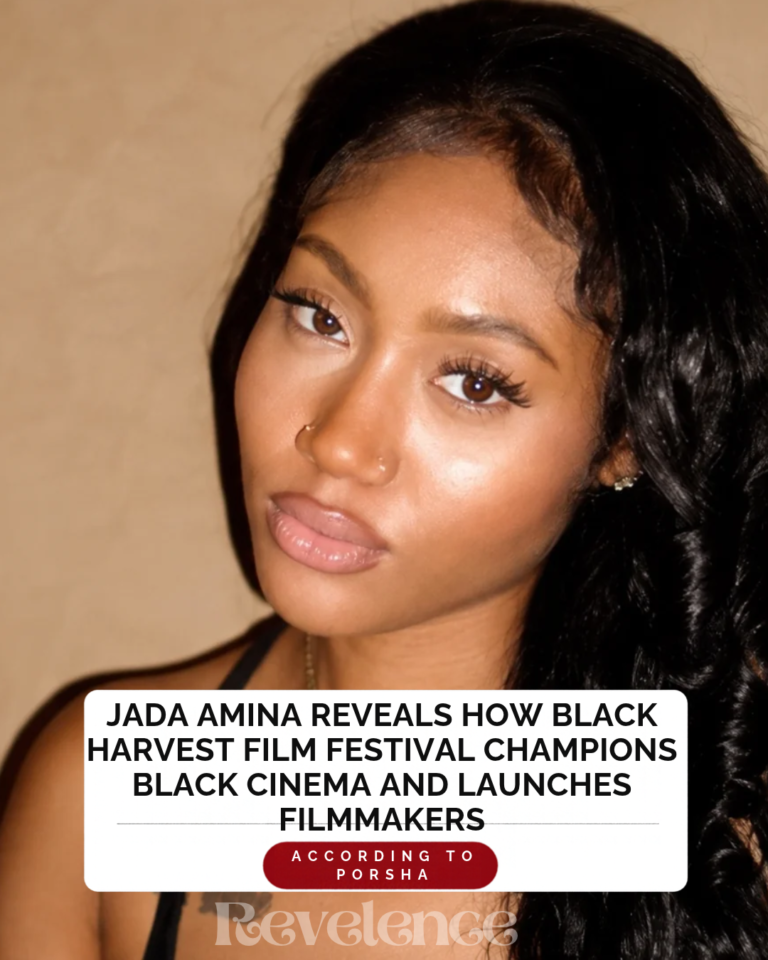
Photo credit: Jada Amina
Black Harvest Film Festival feels like an inheritance to Jada Amina. She grew up attending the Chicago showcase with her mother. Now she shapes its future as lead curator.
The festival celebrates its 32nd year Nov. 6 through 15 at the School of the Art Institute of Chicago’s Gene Siskel Film Center. This year’s lineup features nine feature films, several shorts programs and a restored film by legendary photographer and filmmaker Gordon Parks.
Amina is an artist, a writer and a cultural worker. She also graduated from the School of the Art Institute of Chicago. For her, cultural work means preserving Black stories, sharing them with new audiences and making sure the people who create them receive fair pay.
As lead curator, she champions films that reflect the diversity of Black life. Her approach also challenges the expectation that Black filmmakers must explain their experiences to unfamiliar audiences.
In this interview, Amina discusses her childhood connection to the festival, her approach to curation and the importance of preserving Black cinema. She also shares what emerging filmmakers can gain beyond a screening.
What is the Black Harvest Film Festival, and how did you come to be familiar with it?
Black Harvest is now in its 32nd year. It feels like an inheritance, right? It started before I was even thought of, as we say. The festival began at the Gene Siskel Film Center at the School of the Art Institute of Chicago. The legendary Sergio Mims envisioned it. He has now passed on, and we venerate him as an ancestor and a visionary, alongside Barbara Scharres. She was one of the lead programmers at the Gene Siskel Film Center for a very long time.
The festival continues to usher in Black stories made by Black people, so it’s a for-us-by-us situation over here. We celebrate films that span genre, that also span the world. Of course, we feature local films from Chicago filmmakers and films across the U.S., but also diasporic films. So, films from all over that center Blackness.
Your mother brought you to the festival as a child. What do you remember about seeing Black life on screen?
The Black Midwest is super, super important. We know the Great Migration is what brought us here. My mom was super big on instilling those roots in us, in terms of just giving back. The idea of Sankofa, Each One, Teach One, was very big in my household. She would bring us, because I have a younger sister, to places like the Gene Siskel Film Center and ETA, a Chicago theater company. I was in ballet, but a Black-owned ballet company. I never grew up with an idea that Black folks didn’t have our own enterprises.
I think a double consciousness existed, to reference W.E.B. Du Bois. I know we have our own enterprises, and I know that we bring such beauty and culture to this world, but the world may not always acknowledge that. So I always navigated that, being in multicultural spaces. But at home, and in an extension of home, I had these Black spaces, like Black Harvest.
How does that childhood memory influence your choices as a curator today?
I’m a graduate of the School of the Art Institute of Chicago, which also houses Black Harvest, right? I was navigating these institutions and understanding that we had a place here. We had a story to tell. I know that I’m deeply privileged to have experienced that. It wasn’t far-fetched for me to be in this role, at all, because I had seen it. I had seen people generationally.
At my first Black Harvest that I really, really remember, my mom’s friend’s mom had a brilliant film about her sisters living here in Chicago. My mom had friends in the festival, and I saw people that looked like me. I was like, well, why not? I think that was always my sentiment.
You describe yourself as an artist, a writer and a cultural worker. What does cultural worker mean to you?
Cultural work, as a designation, came to me about a decade ago. I didn’t come up with the terminology, of course. Recently, while programming this festival, I remembered that Toni Cade Bambara, a self-identified cultural worker, writer and organizer, has a film in the festival about her. She has now passed on. She actually passed in 1995, I believe the year I was born. So there’s an interesting transference there. I feel like one of her daughters, and a daughter of so many that way. There are a lot of folks that paved the way.
There’s obviously the word culture. We know what culture means. I think we have a general idea, but work. Why work? That’s because there’s a labor and a level of stewardship that comes with culture. Or there should be. And oftentimes there isn’t, right? So, to steward and get behind the culture, to work to get it out there, to preserve it, to get it in front of people, to share in it. There’s also so much around continuity there. For me, cultural work looks like preserving these stories. It also means making stories as an artist myself.
How does cultural work shape your responsibility to the filmmakers you program?
Getting people paid matters. People often leave us out of the economic value in culture. People profit off of our culture, right? But circulating it is something that I really deeply take pride in.
Earlier today, for another film-related cultural institution that I work with, there was a cancellation. I quickly got the opportunity to call one of my homegirls, a Pulitzer Prize winner, just phenomenal, phenomenal woman. I’m happy to be able to call on these people, right, who are also cultural workers. There wasn’t a fee attached, but I asked, do we have money to pay someone? That’s also part of the cultural work. Behind the scenes, I get people paid. Don’t we like that? We deserve it! It’s our birthright to receive compensation, right, and rewards.
As a curator, you help determine whose work gets seen and remembered. What guides you toward a film that others may overlook?
My rubric is so spirit-based. I have a feeling that this will be sufficient for you. But for the larger, dominant eye, what is my rubric? What am I looking for? I really don’t see with my eyes. Of course, there has to be quality visuals so that I’m not torturing our audiences on the big screen with bad sound and bad visuals. There are also some accessibility things that we’re concerned with. But really, it’s a feeling thing. Are the subjects, whether it’s a documentary or a narrative film, fully realized? Are they fully actualized?
I’ve had conversations with folks who, very righteously, very earnestly speak to these ideas of the stereotype. I know where they’re coming from. Well, I’m not really mad at stereotypes. Stereotypes come from truthisms. What happens is they become reductive, right? So I’m not mad at a thug being depicted. I know some thugs, and I’m not mad at that. I want to see the heart and the spirit behind the work. That can be in a documentary, in a narrative, in a biopic, in a film that is just an experimental short, where there’s no dialogue. But what are we getting at? What is the spirit behind the work?
Which films at this year’s Black Harvest Film Festival might challenge assumptions about Black cinema?
I would love to highlight our shorts. We have 10 shorts programs this year. That is probably around 70 films. Do not quote me on that, I gotta do my math on it. But shorts programs are really a gem of our programming, in that we have a lot of them. We have nine feature films. Some of those films are Dreams and Nightmares, which follows a group of queer Black women on a road trip.
People often ask me, why don’t you have a queer program? Why don’t you have an LGBTQ program? Well, I don’t want to relegate folks to just one program. What if folks are avoiding those stories, right? So you’ll see queer stories throughout the festival. This is a Black film festival. I like to have men and women and elderly people and children within these shorts programs. Dreams and Nightmares will satisfy the very real desire to see that representation.
We also have films like Candy Paint by Nia Imani and her partner Adishola McKende, which are extremely genre expansive. It’s an experimental featurette of about 40 minutes or so that looks at Black culture, Black visual culture, so it’s very bling bling. The film also looks at some of the Black aesthetics of the church and rap music. It really shows how diaspora shows up in Black American visual culture, throughout industries and in all of the things we do.
What are the festival’s must-see honors and closing-night film?
We’re also honoring Walter Thompson-Hernandez with the Visionary Award on Nov. 7 at 8 p.m. Highly suggest that one. We don’t want to miss it. We’re hoping to do a theatrical run with it at our theaters at the Siskel.
And then closing night, if you’re familiar with Gordon Parks. If you’re unfamiliar, you need to see this film. Gordon Parks is an OG, to say the least, a luminary. He’s responsible for so much of our visual culture. If he didn’t have a camera, so much of what we know and remember about ourselves and about our history just wouldn’t exist. He actually adapted the book 12 Years a Slave as Solomon Northup’s Odyssey. There’s a restoration of that film, and that is our closing night film.
How do you build a lineup with something for every kind of audience?
We have films and shorts that portray Black masculinity. They get curious about the Black man and the Black boy child, as well. The program really does span intergenerational stories. To Know Her Is To Love Her is the feminine counterpart to that program.
I call myself a film nutritionist, because it’s a bit like, you got your broccoli, you got your protein. You’re gonna need your fiber. You’re gonna need a little bit of this, and you’re gonna need a little bit of that. We also have After Hours, which gets a little raunchy, gets a little sexy, gets a little scary. That one is great for date nights and late nights. We have a lot to offer. When I say we, I’m saying, yes, Black Harvest Film Festival, but also us. We have a lot to offer.
What becomes possible when a film trusts Black audiences without having to explain everything?
Authenticity, resonance. I come from a very Black American Southern family, so the church is very pivotal in the way we do things, and the way I see things. I mean that from a faith lens, not necessarily a religiosity stance. But even then, it just shows up. I show up with that, even in very white spaces. I consider the theater a secular, sacred space, in that we gather in a room as a congregation, right? There’s a testimony that we are bearing witness to. I really, really like this idea of bearing witness, and I know we’re able to do that.
If you’ve ever been in a space with mixed company, some of the best white and non-Black folks that you could find, there is something that changes when it’s just us in the room, right? We all speak the same language, and I think every culture can speak to that. Of course, we welcome everybody at Black Harvest. In that writers’ room, things change when Black folks speak to Black experiences. There’s a difference, to say the least, right?
How does the Black Harvest Film Festival make room for joy alongside films about injustice and historical struggle?
I leave it to the Black folks who are telling these stories, because that’s all we know how to do. Back to that idea of the stereotype, the reason I’m not mad at a homeboy flick, shout out to John Singleton. We did a retrospective my first year, and we called his son up, Justin Singleton. We showed Baby Boy, and we showed Boyz n the Hood, and we showed Higher Learning. Because there’s so much depth and experimentation. That opening scene of Baby Boy is incredible, with the Tupac poster, if you know, you know. There’s so much that we move through, and there’s so much that we know how to do while speaking our language.
The filmmakers in this festival make my job incredibly easy. We have films that might speak to the Black experience globally, whether your people came through the transatlantic or not. To be Black in this world, we know, comes with imposing, oppressive ideas, and we live in spite of. We’re gonna do it, and we’re gonna laugh, and we’re gonna dance, and we’re gonna do our thing throughout. There’s a joy, because that’s something nobody can take, no matter what bill passes, no matter what they defund. The filmmakers make magic happen, really, with the resources that they do and don’t have.
Which festival programs highlight Chicago filmmakers and experimental work?
Mutual aid and crowdfunding sound like buzzwords, but we’ve been doing that since plantation and prior to. That is just what we do, and the films always speak to that. We have From the Block, a program that we probably won’t get rid of as a program title as long as I’m in charge, and certainly not its content. Its theme is Black filmmakers from Chicago telling stories that touch on Chicago but also are expansive.
Which programs push experimental and documentary storytelling?
Black and Blur takes its name from Fred Moten’s eponymous book. He’s a cultural theorist and a Black scholar, an Afro-pessimist, is what he calls himself. In that book, he really speaks to this idea of legibility and opacity. He speaks to how Black people are seen, and also our interior lives, and how, back to that double consciousness idea, we navigate through the world. That’s the experimental program, because it’s not necessarily legible to a dominant culture or to a dominant eye. They’re playing with form in this way.
Ancestral Futures is another shorts program that features not only some shorts that get experimental and that are narrative, but also has some documentary. Everyday People is another one of those programs that has documentary film and also some narrative. When I say narrative, that’s fiction, right?
I feel really called to the work, and I feel like they’re calling me on the phone, and I’m picking up. It really is that simple for me. I have a hefty amount of discernment as a scholar and historian, and as a cultural steward or lover of my people. So I tend to be drawn to the films that uplift the spirit of Black folks, more often than not.
With new activations at the Obama Presidential Center and the Chicago International Film Festival, what can the Black Harvest Film Festival accomplish that it could not before?
I would say we owe it a lot to the founders of this festival, to Ava DuVernay and to all of the folks who have been doing this work and putting on for us. In my very short years curating, I see a level of tenacity and an unapologeticness that I can only attribute to the folks who came before us. I know what we’re up against now. I know it looked very different. There was certainly a quieting of voices.
We’re often shocked by what happens with the administrations and all the things that take place in this country and otherwise. The reason we’re so flabbergasted is because we’re like, wait, we done been through this, right? I think that’s a testament to their fight, and just continuing to educate and edify ourselves and one another. We know more, too, so when you know more, you do more.
How has technology changed access for Black filmmakers and audiences?
There’s also technology, and there’s more access to being in conversation with us. We could see a video in Colombia. Have you ever seen those videos of Black Colombians rapping? Which we know is a Black American tradition, right? Oral tradition. But also, don’t let my Jamaican friends hear that, because they’ll also say, well, hey, we were doing it. I’m like, no, I hear it, right? So there’s a cultural confluence that I think takes center stage, especially with us having these phones and the internet. You can shoot a video on your phone. Access has changed, and I’m grateful for it. I’m grateful to live in the wake of so much.
What should festival selection lead to beyond a screening for emerging filmmakers?
I do film programming throughout the year, primarily for this festival. So much of it is word of mouth. So much of it is showing up. When you show up for a child, it makes a difference. When we show up for each other, it makes a huge difference.
Why does film restoration matter to the Black Harvest Film Festival?
So much of the work that I find spirited, and that I’m super called to, is our restoration programming. Solomon Northup’s Odyssey, that Gordon Parks restoration, is one example. We have a short that will be part of a special presentation called Black Panthers. It’s a 1968 15-minute short shot on film of the Black Panthers, hardly seen before. Thank you to the incredible folks who do that preservation work to make these films as accurate as they can be to the documentation from that time, for us to sit with, alongside Voices of the Gods.
The distributor for those two films is Newsreel, and I’m grateful for them. But not every film gets distribution. Not every film gets a restoration. Someone has to take interest in those films. If we leave it up to those other than ourselves, there’s a good chance that nobody will restore them.
How can a festival help turn visibility into a sustainable career?
What I know is that the festival market is really important. A lot of these films went to festivals 50, 40 years ago, and one bad review by a gatekeeper kept them from getting distribution. But our voices are more powerful than one gatekeeper. So when we show up, and we go, that’s crazy! Now we can make our own reviews! We don’t have to wait. I mean, they’re still gatekeepers, right? But some of that is reclaiming our power back by showing up for one another, coming to support a film festival, posting it on your Instagram.
I just found out that Jimmy, a film that we showed a few years ago, just got distribution and is now on streaming. We’ve had some films that have won Oscars. I grew up in the same circles as Yashaddai Owens, and that film, Jimmy, is about James Baldwin, a reimagining of his time in Paris as a young man. Our film festival certainly has led to many opportunities. Beyond distribution, there’s times where, in 2023, some filmmakers meet in our lobby or on the red carpet. Then in 2026, I’m seeing that they’re co-producer and director, and they’re from different states or different countries, right?
What does the Black Harvest Film Festival offer that audiences can’t get at home?
That is the beauty of Black Harvest. It’s exciting to see how things unfurl from the moment they hit our submission portals, to the time they hit the screen, and then after the experience. We also have Q&As, where folks are able to be in conversation with directors, give feedback and question alternative endings. That’s the power of the festival. You can’t get that at home on your couch, and don’t get me wrong, I love a Netflix and chill moment. I like to relax at home as well. But we know there is a real necessity to get out into the theaters and really show up for community before they have the opportunity to find you at your home.
Can audiences attend the Black Harvest Film Festival virtually, or only in person?
We offered virtual attendance, because we had to in 2020. It is so different, and it’s really, really hard work. The quality of the film, you’re gonna have to come join us.
For first-time attendees of the Black Harvest Film Festival, which film or experience would you recommend?
I’m gonna give you three real quick. I’m gonna say opening night, Nov. 6, you’re gonna wanna be there. We hand out our Richard and Ellen Sandor prizes for the best feature and short. We won’t play the feature, because we can’t keep everybody there all night. But we will be showing some of the festival highlights, as well as the winner of the shorts program, and presenting awards that night. We also have a little reception, a little champagne toast afterwards, so that’s exciting. It just builds so much momentum for the fest itself.
Then, like I said, the Visionary Award will be incredible. I know it will do really, really well, and we’ll probably see some award shows. It’s a great opportunity to see it first, here in Chicago, and just be in conversation with the filmmaker. I’ll be in conversation with Walter that evening.
What do you hope stays with people after they leave the festival?
And then closing night. If you can’t make it in the middle, at least come close out the party with us. There’ll probably be some champagne as well, and some snacks. It’s the opportunity to see a film that, for a while, I would consider unsung. Our work is to champion these films, and if we have the opportunity to re-present them to new audiences, let’s do it. Y’all will certainly be in for a treat if you come to any of the screenings, but especially those three.
Where can people find more information about the Black Harvest Film Festival and support it beyond attending?
Black Harvest does not have, and I will repeat, it does not have its own festival Instagram. You can follow us at Film Center on Instagram. Black Harvest Film Festival has its own site, it’s saic.edu/blackharvestfest, but just Google Black Harvest, we come up. We’re green this year. We’ve been switching out our colors, and green is prosperity, is money. I’m feeling really good about this festival. Just continue to repost and get the word out there, and submit. If you have a person in your life who is interested in film, tell them there’s no excuses if they have a phone. I always say to folks, and audiences, each one of y’all can have a documentary. Ain’t nobody more special than the other. Everyone’s story is important, and I encourage you all to tell them.
Submissions open on FilmFreeway.com, if you familiarize yourself with that website. If you’re a filmmaker or aspiring filmmaker, or if you know somebody, a lot of film festivals use it, and we use it. It’ll open up in the new year. I work year-round for this festival, so as soon as one ends, I’m already thinking about 2027.
Source: According to Porsha, featuring Porsha Monique and Jada Amina
About the Author