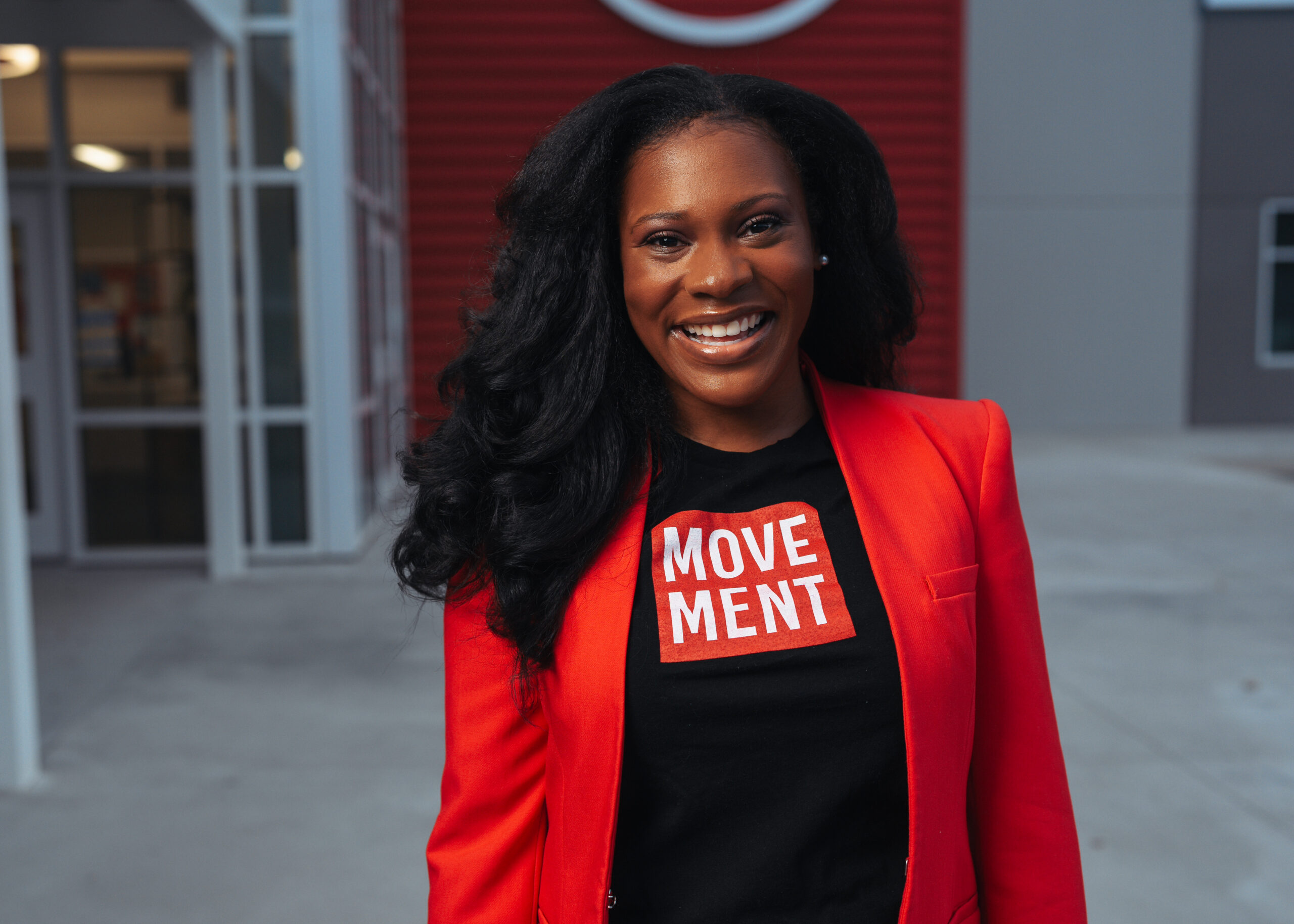
Photo credit: Kerri-Ann T. Thomas
Kerri-Ann T. Thomas was never supposed to become a success. At least, not according to the statistics.
Born to Jamaican parents and raised in Brooklyn, she entered elementary school already knowing how to read. A teacher told her she couldn’t, simply because of her accent. That moment didn’t break her. Instead, it became the foundation of everything she has built since. From classroom teacher to principal to superintendent to CEO, Thomas has spent her entire career disrupting what people have already decided is possible for children who look like her.
She is building more than schools
Today, as CEO of Movement Schools, a network of pre-K through fifth grade schools in Charlotte, North Carolina and Atlanta, Georgia, she is not just running a school system. She is building an ecosystem designed to close generational gaps through world-class instruction, financial education, and a philosophy that centers families as whole human beings, not just students on a roster. She is also a children’s book author and the founder of Brooklyn T, a tea brand rooted in her Jamaican heritage.
She sat down to talk about the teacher who silenced her, the school she turned into number one, and why she pushed back when someone suggested her schools offer affordable housing.
When you look back at the teacher you were at the beginning of your career, what did she understand about children that still guides the CEO you are today?
Even as a teacher, I cared deeply about the kids in front of me. I showed up for them beyond the four walls of the classroom. That mindset and those principles still guide me now as a CEO. The question I ask is: how do I care deeply about the people I am serving? Of course, I am serving far more than 30 students now. Thousands of students, thousands of teachers, and hundreds of leaders all depend on how I show up. So how am I demonstrating deep care for them as humans first?
Showing up for them also means getting into the work with them and getting into the weeds. My students were most successful because they knew I cared deeply and because I showed up for them even after 3 o’clock. That bell never existed for me. Operating the same way now is something I am deeply committed to. There is no bell that signals the end of this work.
You grew up in Brooklyn as the first person in your family born in America, with Jamaican heritage on both sides. How did your upbringing shape your understanding of what access and opportunity can change in a child’s life?
At a very young age, I saw exactly what access meant and what blocked it. I entered school already knowing how to read, because education was deeply valued in my household. However, during a reading exercise, my teacher told me I couldn’t read. The reason was simple. Jamaicans don’t pronounce the letter H. So when I read the title Cat in the Hat, it sounded like Cat in the At. That teacher didn’t understand my accent, and that misunderstanding shut me down. I stopped reading aloud, even though I loved reading.
I bring that up because I also watched my mother face the same thing. Whenever she spoke, people would question her intellect based solely on her accent. Watching her access get blocked just because of the way she sounded shaped everything about how I see opportunity. Those experiences drove me into this work and made me deeply passionate about genuine access. Not just getting people through the door, but preparing and setting them up for success once they are inside.
When did you first realize that education could interrupt a child’s environment and change their future?
Honestly, it was the TV shows I was consuming at a young age. The Cosby Show, A Different World. I was absolutely obsessed with them, even in elementary school. Those shows depicted a lifestyle and a world I didn’t know. Nobody in my family had gone to college. Doctors and lawyers were not people I saw in my community growing up. But I had this deep affinity for those shows, and I wanted to replicate that life for myself.
It shows you the power of positive imagery. That exposure shaped my view and made me believe I could get out of my circumstances. I wanted to go to Spelman specifically, and I only applied there because that is how certain I was. My mom’s friend worked on the set of A Different World and surprised me for my birthday with a visit to meet the cast. I told them how much I wanted to go to Hillman, and they told me to go to Spelman. I said got it and never looked back.
As a principal, you led a turnaround school to significant growth and ultimately made it the number one school in Hartford, Connecticut. What did you see in that school that others had stopped seeing?
It was very clear to me that other people had stopped seeing what was possible. They stopped seeing the children, and they also stopped seeing the role they personally played in the results. The moment you remove yourself from the outcome, the work is doomed to fail.
From the very beginning, I was clear on one thing: there is nothing wrong with the children we serve. Anything happening in that school is within our control, especially with the adults who are serving those students. That mindset shift was the entire focus of that school year. Everything happening in that building was a reflection of me. How each classroom looked was a reflection of that teacher. Pushing educators to model the excellence they expected from students was non-negotiable for me. You cannot come to work late and then question why students are not achieving. Your mindset impacts your behaviors, and your behaviors show up in how you treat the children in front of you. Focusing on that mindset work led us to make history. We led the strongest turnaround that organization had ever seen.
You have now led at virtually every level in education. What do you understand as a CEO that you couldn’t fully see from inside the classroom?
As a classroom teacher, your world is the 30 students in front of you and their families. The information you have is limited to that room. At the executive level, you are exposed to the full ecosystem. The political landscape, real estate, economic forces, and systemic barriers all shape what is possible for students.
Thinking not just about the size of the organization today but about the growth and scale we are trying to achieve over the next ten years is something I do constantly. All of those factors make the job very challenging. As a Black person in America, you know barriers exist conceptually. However, when you are sitting across from someone who is actively refusing to sign a bill that would increase funding for schools, that is a completely different level of understanding. Fighting the misconception that charter schools take children away from public schools is something I do regularly, when the truth is that charter schools are public schools. Families pay nothing to attend. We are expected to do more with less. Seeing how that system operates from the inside changes everything about how you lead.
The name Movement Schools suggests something bigger than a building. What is the movement you believe you are building?
Our mission is to love and value our scholars and communities through leading a movement of excellence in education. In partnership with families, we equip scholars with the tools to close generational gaps through self-efficacy, world-class instruction, and financial education. Closing generational gaps is not an easy feat. Most organizations wouldn’t even take that on. We are bold enough to say we will.
Even though we primarily serve pre-K through fifth grade, we extend that mission into the community through our connection to Movement Mortgage. If you are a Movement staff member or a Movement parent and qualify for a loan, Movement Mortgage will subsidize certain costs to help our families purchase homes. Home ownership is one of the most powerful ways to close generational gaps and build community wealth.
When I first joined as CEO, someone suggested we focus on affordable housing. I said no. Affordable housing keeps families relying on a system that holds them in place. I am not in that ministry. I am in the business of helping families afford homes and building the ecosystem that makes ownership possible. That is the difference, and that level of intentionality is what I mean by the movement.
We are raising children in the AI generation. What should schools be teaching today that was not nearly as urgent when you first entered the classroom?
Regardless of the wave, whether it is AI today or computer science before that, nothing beats raising critical thinkers. Nothing beats building confidence, pride, and a sense of belonging in our children. With so much access to information, students need the ability to sort through what is real and what is not. False narratives and agendas are being pushed constantly, and we have to equip our kids to critically analyze and question the information they receive.
I am a fan of AI and the efficiency it can create. However, it should never replace the thinking our children need to do. I use Claude and ChatGPT regularly, and I still catch their errors. These tools are imperfect. Our brains cannot switch off just because a tool can make things move faster. Preparing our children not just for AI, but for leading the next generation in whatever industry calls them, is the real goal. Critical thinking will always be the foundation.
You are a CEO, a children’s book author, and the founder of Brooklyn T, a tea brand. What connects all of these seemingly different paths?
They all reflect a belief in being bold and disruptive. Statistically, I am not supposed to be here. So everything I do is about disrupting what people have already predetermined for someone like me and doing it loudly, authentically, and with full commitment to my values.
The tea brand is rooted in my Jamaican culture. Tea is what we drink. Launching a tea brand in America, where coffee dominates, is a bold move. At Movement Schools, being intentional about how we circulate dollars is another form of disruption. Many schools use large national food vendors for lunch. Instead, we use a local Black-owned business across all of our schools. That level of intentionality about where the money goes is very deliberate. The children’s books follow the same spirit, tackling bold and real topics that are not often found in books for young readers.
Your children’s book Roll Call deals with identity and embracing what makes us unique. Why was that message important enough to put in a book?
Roll Call is about a teacher mispronouncing a student’s name during roll call and the student never correcting her. The student’s name is Babisha, and I got the idea from my sister, whose name is actually Babisha.
In high school, I read an article about how the likelihood of getting a job is impacted by the name on your resume. After reading it, I ran home and told my sister she needed to change her name. She refused. Looking back, that moment revealed how much I had already internalized harmful beliefs about identity and beliefs I needed to unlearn. At Spelman, conversations about names as cultural identifiers and community markers changed my thinking completely. That experience inspired the book and served essentially as an apology to my sister.
Before publishing, I read it to my first-grade class. One of my students, Katie Lopez, raised her hand and said she always wanted a name like Babisha. She said teachers remember those kids and not the Katies. That perspective changed everything. I rewrote the book to include both voices and dedicated it to Katie Lopez and my sister, Babisha Thomas. The message is simple: whether your name is Babisha or Katie, love and embrace it completely. Katie is now a senior at Cornell University, and I could not be more proud.
Where can readers find Roll Call?
Roll Call by Kerri-Ann T. Thomas is available on Amazon and Barnes and Noble.
Imagine one of your students finds this interview 20 years from now. They are successful and leading their own community. What would you want them to hear you say?
I expected nothing less. That is exactly what I expect them to do. I expect my kids to lead, to run companies, to run circles around any table they sit at and beyond. It is not a hope. It is an expectation I have always held for them. So my answer is simple: duh.
Follow Kerri-AnnTThomas Instagram and LinkedIn @KerriAnnTThomas. Learn more about Movement Schools at movementschools.org. Schools are cn urrently located in Charlotte, North Carolina and Atlanta, Georgia, with plans to expand across the Southeast.
Source: According to Porsha, featuring Porsha Monique and Kerri-Ann T. Thomas
About the Author