


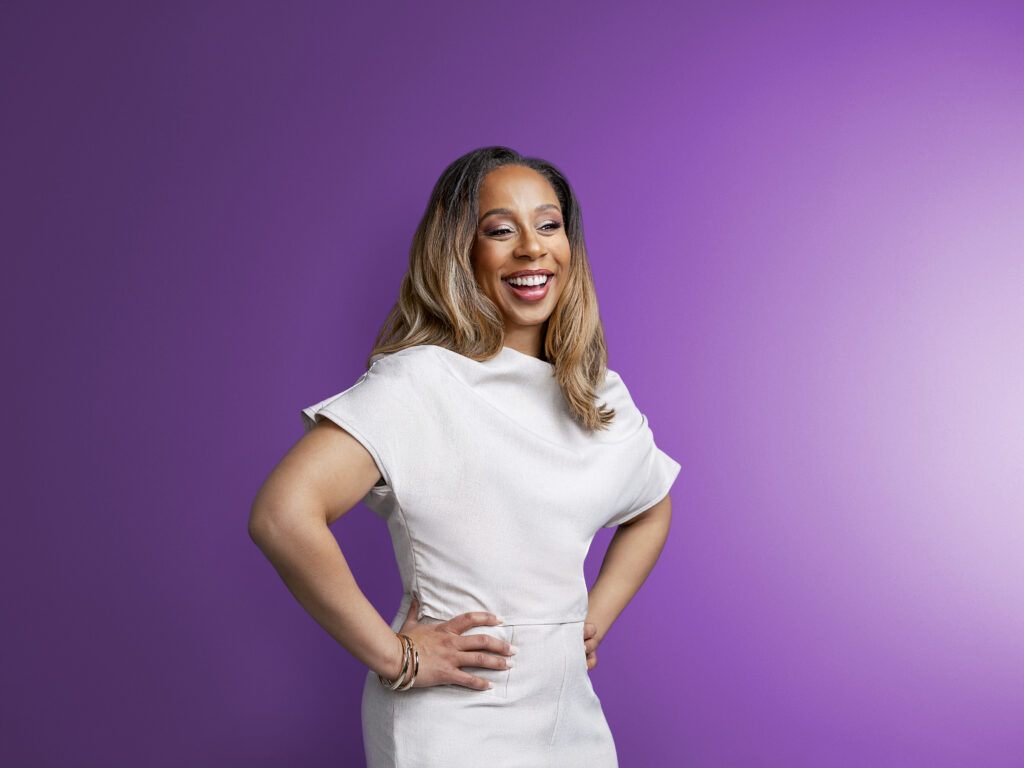
Leah Collins understands the devastating cost of avoiding money conversations. After spending 20 years managing corporate finances, she had a sobering realization while doing her taxes in 2017: she’d been ensuring companies stayed profitable while neglecting her own financial health. Within 18 months, she transformed her life by paying off $40,000 in debt and increasing her credit score above 800. But her biggest lesson came in 2019 when her engagement ended the month of her wedding due to financial incompatibility. That painful experience became her purpose. Now as host of OWN‘s Maxed Out, Collins helps families face the uncomfortable money discussions that can make or break relationships, proving that financial freedom starts with honesty, courage and action.
How did you get into the financial coaching industry?
I have 20 years of corporate finance and audit experience and back in 2017 I was doing my taxes and I had made the most money I had ever made that year. So while I had been managing corporations’ bottom lines, making sure they were making a profit, I realized I hadn’t been doing the same for myself. I wasn’t struggling, but I wasn’t thriving either. So at that point, I made it a goal to pay off all of my debt and really just try to obtain financial freedom. Within 18 months, I paid off $40,000 worth of debt, increased my credit score to over 800 and purchased investment properties. At that point, friends and family reached out asking for help and that’s when I launched my coaching business. The business has evolved. Initially I started off just helping my peers basically. And then in 2019, I had an engagement end like the month of the wedding due to many reasons, but largely due to financial incompatibility and not having those taboo, scary, money conversations. So that’s kind of how I pivoted into the money and relationships part of the business.
What made you realize this work was about purpose, not just money?
Just when I saw the impact that it had on my life. It opened up so many doors and opportunities and just the power that it gave me to walk away from unhealthy toxic relationships because I’ve had to do that. And I was able to do that because I had the money to do it. Walk away from toxic jobs. It just gives you so much power and opportunity and doors that are open to you when you don’t owe people money. You can just move differently when you don’t have that burden on your shoulders.
Why do you call Maxed Out a financial intervention series?
Money rarely touches just one aspect of our lives. It touches every single aspect of our lives where we live, where we work, where our kids go to school, what kind of foods we eat and also impacts our relationships. It’s called a financial intervention series because in every episode there is a nominator and a nominee and the nominator nominates the nominee because the nominator is directly impacted by this person’s poor financial decisions. So that’s why it’s called a financial intervention because we’re coming in, intervening, saying, hey, you need help. We need to stop people before you get to rock bottom. Some people are already at rock bottom and really turn it around and give them a reset.
Why do couples avoid money conversations until reaching a breaking point?
I think a lot of it is just due to how we were raised. My parents didn’t really talk about money. I knew there was tension in the household because of money. So a lot of that comes from our childhood, how we were raised, embarrassment, shame. We don’t want people judging us. And it’s really a shame because money conflict is the number one reason for a divorce. It’s the reason I called off my wedding because it was uncomfortable having those discussions. It was so uncomfortable and people are just scared to have them.
What are the financial red flags couples should address before resentment sets in?
I actually did a whole TED Talk on this. It’s called the three don’ts before you say I do. One financial red flag for me, especially at this point in my life, is if someone is just afraid to talk about it. You have to have those discussions. It’s very important to have those discussions. And you don’t have to make the same amount of money as your partner, both have great credit scores, but you do both need to have the same vision. So you really need to talk to each other, make sure you’re on the same page as far as vision because you’re combining your finances and you want to make sure that this person is not going to ruin your life. Because I see that all of the time. So that is the number one red flag that I see is just not being open and willing to talk about these types of issues.

What’s the emotional cost of avoiding financial honesty in relationships?
It just really takes a toll on your relationship in general. I can’t get turned on if I’m stressed out, if I can’t pay the bills. That’s a complete turn off. I can’t even sleep at night because if something happens, they were less than one paycheck away from homelessness.
How often do you see parents, especially mothers, put themselves last financially?
All of the time. It is so common. And the cost is the cost of retirement. Both Ms. Diana and her husband are over the road truck drivers and they are in their 60s with no retirement. That is a hard life. That is a hard job to do at any age, especially in their 60s. So that’s the cost. You’re enabling these grown adult children who are able-bodied, willing to work at the cost of your own retirement. People work until they die when they could have saved that nest egg and this is the result.
How do you help women shift from survival mode to financial strategy?
To really help them understand their worth and to really create a vision. They are living from paycheck to paycheck. They can’t think past Friday when that next paycheck drops. So really helping them gain a vision in their goals and helping them really work towards those goals. You can’t work towards what you don’t see.
What would you say to parents who feel guilty about past financial decisions but want to move forward?
I would say that it’s never too late to start. You can start anywhere. The best time is always today. Just start creating those boundaries now. Come up with your goals, create your vision and start working towards them. It’s never too late to start.
Why is financial transparency so essential in healthy relationships?
Financial transparency is so important to relationships because you don’t want to have surprises. A very common issue in relationships is what’s called financial infidelity. It’s basically when you’re hiding purchases or hiding credit cards, hiding things from your partner. If you’re married and your husband takes out a credit card and runs up $40,000, I think you want to know that. It really depends on what your understanding is and that goes back to that transparency and that communication. That’s why it’s especially important in romantic relationships when you’re married because that directly impacts you too. That’s your debt too.
How do you heal an unhealthy relationship with money?
I’m a perfect example of that. Growing up, have you ever seen that show Everybody Hates Chris? The father was like turning that money, two cents of electric, that was my father growing up. And money was always tight. I remember I was about seven years old, we couldn’t afford going back to school clothes. And I wanted to know why so my mom sat me down and showed me the budget and what was left at the end of the month. And so I was terrified. I didn’t ask for anything for pretty much the rest of my childhood. And that shaped me up into adulthood. And it wasn’t until three years ago where I realized, it’s okay, Leah, you can spend money. I needed chapstick and I had just bought some chapstick and I lost it. I was like, no, I’m not gonna buy anymore, I just bought some, I’m gonna find it. And one of my friends was like, Leah, just go buy some more chapstick, just go buy it. And that’s when I realized it’s okay. And that’s kind of when I started healing. But another thing that I do is therapy, financial therapy, regular therapy, and I listen to a lot of podcasts, I read a lot of books. It really just comes down to the information gap, that knowledge gap, just really learning what you don’t know goes a long way.
How do you balance accountability with compassion when emotions are high?
It starts with building trust. I don’t come in going hard on people. I really want to know them as a person, understand where their pain points are, where they came from, their money mindset, money mentality, how they grew up with money, and really just relating to them. I like to tell a lot of personal stories about how I grew up and things that I went through. So really creating that bond. And then they begin trusting me and know that when I do have to have those tough love moments that I’m coming from a good place.
What are three practical steps someone can take today to regain financial control?
Well, the first thing you can do is go look at your credit report. You can go to annualcreditreport.com and look at your credit report with the three bureaus, the three different credit bureaus and see where your credit stands. If there are any collections that shouldn’t be in collections, just figure out where your credit stands. Also, I talk a lot about setting your goals. It’s January, we’re off to a new fresh start. Really sit down and figure out where you want to be a year from now, five years from now, 10 years from now. And then that gives you something to strive for. Just really putting that on paper and putting those goals in place.
What’s one small financial habit that creates massive long-term change?
Automate your savings, automate your investing. Automatically have a certain portion of your paycheck go towards the savings account at a bank, a different bank than where your checking account is. That way you don’t see it and you forget about it. It’s harder to touch it and transfer that money.
Why is the financial literacy conversation still so urgent in the Black community?
It’s so urgent because silence kills generational wealth. It destroys it. And that’s something that we as Black people, especially, cannot afford to do over with every single generation. And I encourage people to at least get term life insurance, get an estate plan. One of the first things when my daughter was born is I got a trust together and put all my assets in a trust so that way if anything happens to me, those assets get passed down to her. So not only building the wealth, but protecting the wealth as well. And it’s also the information gap. It’s not always just passing down money. It’s also passing down information.
How do you hope Maxed Out reshapes the way families talk about money?
I really just hope it normalizes these conversations. We are on this show, we’re modeling how to have tough money conversations because the nominator and the nominee are forced to have them. And so I just hope that this show is creating the blueprint for people to sit around their kitchen table and have those conversations without shame.
How can people watch Maxed Out and follow your work?
You can follow me on Instagram @theleahmariecollins. You can watch the show. It airs every Saturday on OWN at 8 p.m. You can watch it on OWN, Hulu, HBO Max and Discovery Plus.

About the Author




1 thought on “OWN’s ‘Maxxed Out’ Host Leah Collins Turned Heartbreak Into Financial Freedom, and a Blueprint for Millions”