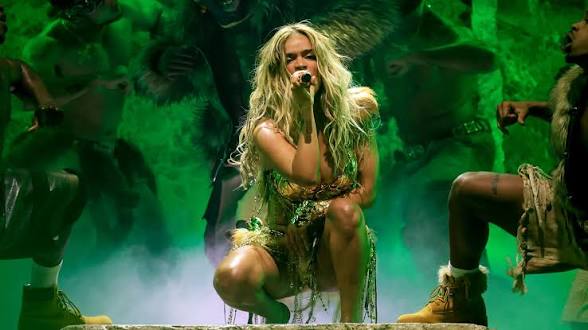
Courtesy;Karol G

When Karol G walked out onto the main stage at the Coachella Valley Music and Arts Festival in Indio, California, she was not just headlining one of the world’s most watched music events. She was doing something no Latin woman had ever done before her and the crowd gathered in the desert knew exactly what they were witnessing.
The Colombian artist, born Carolina Giraldo Navarro, delivered a performance that was equal parts celebration and statement, radiating the kind of confidence that comes from years of quietly dismantling barriers while the world slowly caught up to what Latin music had always been capable of. For the thousands packed in front of the main stage and the millions watching online, the moment carried a weight that went far beyond a single set list.
A career built on breaking records
Karol G did not arrive at Coachella’s headline slot by accident. Her ascent to the top of global music has been one of the most deliberate and impressive trajectories in recent memory, built on a foundation of reggaeton, Latin pop, and trap sounds that crossed language barriers with remarkable ease.
The release of her album Mañana Será Bonito marked a turning point not just for her career but for Latin music as a whole. The project debuted at number one on the Billboard 200 chart, making her the first female artist to achieve that milestone with a Spanish language album a record that underscored just how dramatically the appetite for Latin music had grown among global audiences.
From that moment forward, Karol G operated at a different level. Arena tours sold out across multiple continents. Festival bookings grew in prestige. Collaborations with artists across genres expanded her reach even further. Each achievement built toward something larger, even if few could have predicted it would culminate in a Coachella headline slot that rewrote the festival’s own history.
What the moment meant for Latin music
The significance of Karol G’s Coachella headline performance extended well beyond her own career. Latin artists have long commanded enormous global audiences, yet the most prominent slots at major international festivals have historically gone to English language acts. Her appearance in that top position represented something the Latin music community has been building toward for years.
The performance highlighted a broader and accelerating shift in the music industry, one in which Spanish language artists are no longer content with supporting roles on the world’s biggest stages. Karol G’s headline slot was the most visible confirmation yet that Latin music has arrived not as a guest but as a defining force in global popular culture.
The crowd and the internet responded
Inside the festival grounds, the reaction was immediate and overwhelming. Fans sang back every word of her biggest hits throughout the set, creating the kind of communal energy that defines the most memorable Coachella performances in the festival’s history.
Outside the grounds, social media moved just as fast. Clips from the performance spread rapidly across platforms, with viewers around the world celebrating both the quality of the show and the magnitude of the milestone it represented. Within the Latin music community specifically, the response carried a particular emotional resonance a collective recognition that something genuinely significant had just taken place on one of music’s most visible stages.
For Karol G, a night that began as a headline performance ended as something considerably more enduring a place in music history that belongs entirely to her.
Source: The Express Tribune
About the Author