MOSQUITO IN THE EAR Reveals a Powerful True Family Story
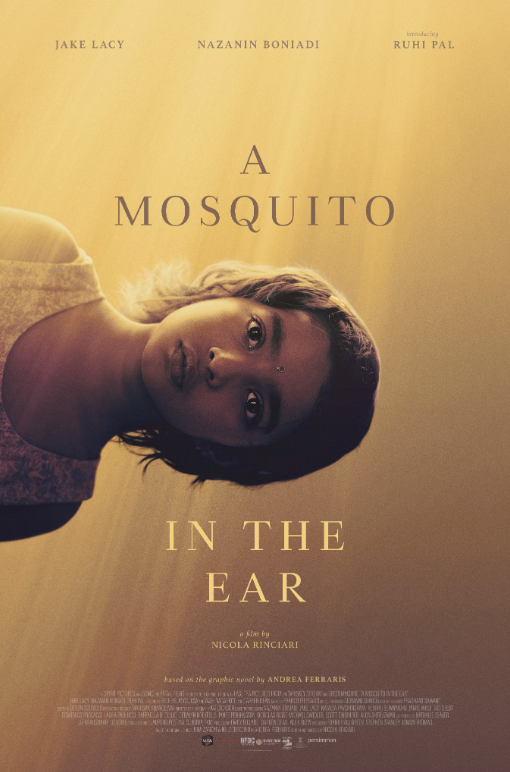
Photos Courtesy of Persimmon
A Mosquito in the Ear brings a deeply human story to the screen, exploring the emotional complexities of international adoption and the fragile process of building a family. The film is inspired by a true story and adapts Andrea Ferraris’ graphic novel of the same name.
The project marks the feature directorial debut of Nicola Rinciari, who also co-wrote the screenplay. The film runs just under 90 minutes and blends drama with quiet emotional tension as it follows a couple navigating an unexpected personal crisis.
Starring Jake Lacy and Nazanin Boniadi, the film introduces audiences to a story that unfolds far from home but centers on universal questions about love, responsibility, and belonging.
A journey to India that changes everything
The story follows Andrew and Daniela, a married couple who travel to Goa, India. Their goal is to bring home their newly adopted four-year-old daughter, Sarvari.
What begins as a long-awaited family milestone quickly shifts into emotional uncertainty. Sarvari resists leaving the only home she has ever known, creating an unexpected conflict that tests the couple’s expectations and emotional readiness for parenthood.
The narrative focuses on how adoption is rarely a straightforward transition. Instead, it shows how deeply personal and unpredictable the process can become, especially when cultural and emotional bonds complicate legal arrangements.
Rather than presenting a simplified version of adoption, the film examines how attachment, identity, and belonging collide in real time.
A grounded portrayal of emotional strain
As Andrew and Daniela remain in India longer than expected, their relationship begins to feel the strain. The film highlights how external pressures can expose internal fractures within a marriage.
Both characters are forced to confront their assumptions about family life and what it means to become parents under difficult circumstances. The emotional tension builds gradually, reflecting the uncertainty of their situation rather than relying on dramatic escalation.
The young character Sarvari becomes the emotional center of the story. Her reluctance to leave her environment introduces a powerful dynamic that reshapes the couple’s understanding of adoption and responsibility.
Directorial debut rooted in realism
Director Nicola Rinciari approaches the material with restraint, focusing on natural performances and grounded storytelling. His direction avoids sentimentality and instead emphasizes emotional realism.
The production brings together experienced producers, including Darren Dean, known for work on The Florida Project and Tangerine, along with several international collaborators who helped shape the film’s cross-cultural setting.
Production in India played a key role in grounding the story’s authenticity. The setting in Goa becomes more than a backdrop, shaping the emotional rhythm of the film and influencing the characters’ decisions.
Festival recognition and early reception
A Mosquito in the Ear premiered as the opening film at the Santa Barbara International Film Festival. It also received the Panavision Spirit Award for Independent Cinema, signaling early recognition for its storytelling and performances.
The film has been noted for its focus on cultural sensitivity and its portrayal of international adoption without romanticizing the process. Early festival responses highlight its emphasis on emotional nuance and character-driven storytelling.
A quiet but impactful story about family
At its core, A Mosquito in the Ear explores what it means to become a family when expectations collide with reality. The film avoids easy resolutions and instead focuses on the emotional weight of difficult decisions.
With strong performances from Lacy and Boniadi, the film builds a portrait of love shaped by uncertainty, distance, and cultural complexity. It presents adoption not as a destination, but as a process that can reshape everyone involved.
The result is a thoughtful drama that lingers on questions rather than answers, offering a reflective look at the unpredictable path of forming a family.
Source: Press materials
About the Author