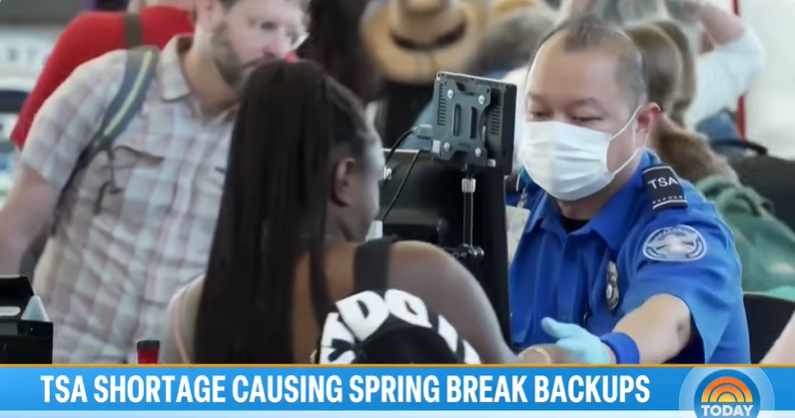
Courtesy:Today
The timing could hardly be worse. Just as millions of American families are heading to airports for spring break, the Transportation Security Administration is grappling with a growing staffing shortage triggered by the partial federal government shutdown — and passengers across the country are already feeling the effects.
More than 300 TSA officers have resigned since the shutdown began, according to the agency, and those departures are translating directly into longer wait times and mounting frustration at security checkpoints in airports throughout the United States. For travelers who planned their vacations months in advance, the disruptions are proving to be an unwelcome reality check before their trips have even properly begun.
What the shutdown is doing to airport operations
The partial government shutdown has placed federal workers in a difficult financial position. Many TSA officers are required to continue working without receiving their regular paychecks, a situation that has historically prompted some employees to seek more stable employment elsewhere. The wave of resignations currently affecting the agency reflects that pressure, and officials have not offered a clear timeline for when the situation might stabilize.
The departures are not simply a numbers problem each resignation removes a trained, experienced officer from a security operation that depends on consistent staffing to function efficiently. Replacing those officers takes time and resources, particularly at large, high-traffic airports where demand is already at its peak during the spring travel season.
The backups are being reported at checkpoints across the country, with some travelers describing unusually long lines and reduced screening lanes. Airport authorities in multiple cities are monitoring the situation closely, though there is limited capacity to compensate for a federal workforce shortage through local measures alone.
Spring break travelers caught in the middle
For the families, students, and vacationers who chose this particular week to travel, the disruptions represent a stressful and largely unavoidable complication. Spring break is one of the busiest travel periods on the domestic calendar, and airports were already anticipating record-level passenger volumes in the days ahead.
Travel experts have generally advised passengers to arrive earlier than usual at airports during the shutdown period, building in additional time to clear security without risking missed flights. Airlines, for their part, have encouraged travelers to check in online and minimize carry-on complexity to help speed up the screening process where possible.
The broader concern, however, extends beyond the immediate inconvenience. A prolonged shortage of security personnel raises questions about the longer-term health of the TSA workforce and whether the agency will be able to fully rebuild its staffing levels once the shutdown ends. Officers who resign during a shutdown do not necessarily return when federal funding is restored — many move on to other careers, leaving the agency to recruit and train new hires from scratch.
The bigger picture
This is not the first time a government shutdown has created turbulence at American airports. Similar disruptions have occurred during previous shutdowns, and advocates for federal workers have long argued that requiring essential personnel to work without pay creates both financial hardship and operational risk.
As of now, lawmakers have not reached a deal to end the partial shutdown, leaving TSA leadership and airport administrators to manage the fallout in real time while one of the year’s most demanding travel seasons gets fully underway.
Source: NBC News / TODAY
About the Author