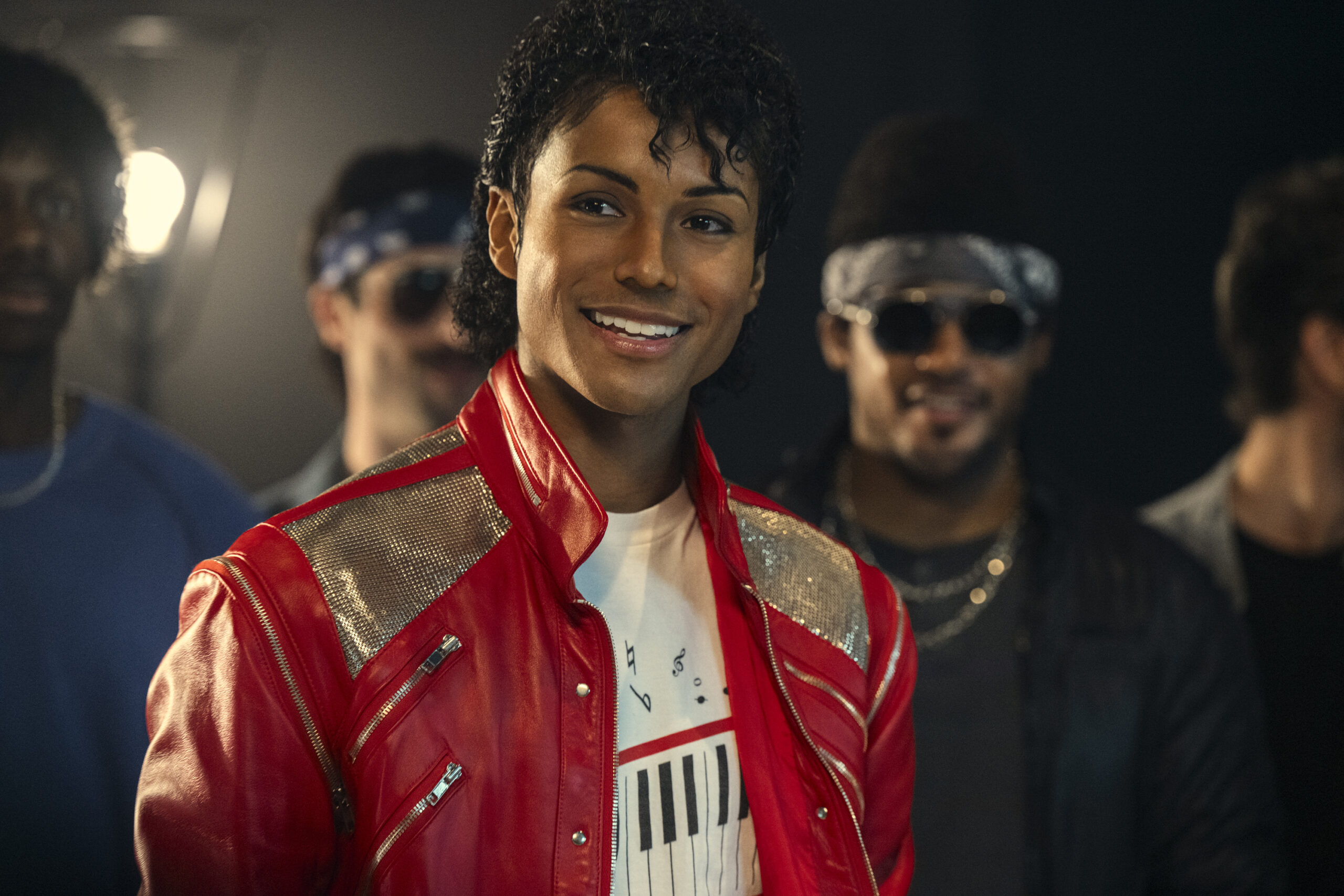
Jaafar Jackson as Michael Jackson in Maven. Photo Credit: Glen Wilson

Michael film worldwide earnings have already rewritten what a music film can achieve. In fact, the numbers are only part of the story. Directed by Antoine Fuqua, “Michael” stars Jaafar Jackson as the King of Pop. In just over a week, it has pulled in $424 million globally. As a result, it now ranks among the most commercially successful music films ever made. Still, a closer look at its reception tells a different story. Both audiences and critics have responded to the film and they could hardly disagree more.
Michael Jackson biopic breaks 5 powerful box office records
The film, distributed by Lionsgate, launched to a $97 million domestic opening weekend on April 24, a figure that immediately set it apart from its peers. Michael Jackson biopic breaks 5 powerful box office records That debut alone positioned it as the highest-grossing music biopic centered on an American artist, surpassing all previous benchmarks in that category.
To understand the scale of that achievement, the film outpaced celebrated predecessors that had long held the standard for the genre. The combination of global curiosity about Jackson’s life, elaborate stage recreations, and the highly publicized casting of his nephew Jaafar Jackson proved to be a powerful draw for audiences worldwide. Here are the 5 records the film broke in its opening week: 1. Highest domestic opening for a music biopic, 2. Highest global opening weekend for a music biopic, 3. Fastest music biopic to reach $100 million worldwide, 4. Highest-grossing music biopic centered on an American artist, and 5. Biggest Lionsgate opening of 2026.
What the film covers and what it deliberately leaves out
“Michael” traces Jackson’s journey through two defining chapters of his life: his early years performing with the Jackson 5, and his triumphant 1988 headline run at Wembley Stadium, which became one of the defining moments of his career. The film features detailed recreations of his most iconic performances, including a version of “Thriller” that has drawn particular praise from fans for its visual faithfulness.
Notably, the film ends in 1988 a deliberate creative choice that keeps it well clear of the controversies that defined the later decades of Jackson’s life. Filmmaker Spike Lee, a longtime Jackson admirer, publicly acknowledged that decision and defended the film’s scope, pointing out that it set out to celebrate a specific era rather than provide a comprehensive biography.
The 97% vs. 38% divide
Here is where the story gets complicated. On Rotten Tomatoes, “Michael” holds a 38% critics score a figure that reflects widespread criticism from reviewers who have described the film as overly reverent and unwilling to engage with the more complex dimensions of Jackson’s legacy. Words like “sanitized” have appeared repeatedly in professional assessments, with many critics arguing the film functions more as a tribute than a biography.
Audiences, however, have reacted in almost the opposite direction. The film carries a 97% audience score on the same platform a gap that rarely appears in such stark terms. Fans have responded warmly to Jaafar Jackson’s physical resemblance to his uncle and to his performance overall, crediting him with capturing the musician’s distinctive stage presence and movement with remarkable accuracy. The faithful recreation of Jackson’s music throughout the film has also been a consistent point of praise.
A cultural moment regardless of the reviews
Whatever critics may think, the trajectory of “Michael” reflects something that goes beyond any individual film. Jackson’s cultural footprint has remained remarkably durable decades after his peak years, and the appetite for a big-screen celebration of his artistry appears to have been genuine and widespread.
With its opening-week earnings and record-setting domestic debut, the film is on course to become one of the biggest theatrical releases of 2026. The conversation around it who it is for, what it chooses to show, and how audiences have claimed it as their own despite critical resistance may prove just as enduring as the music it celebrates.
Source: Marca
About the Author