Courtesy:CBS
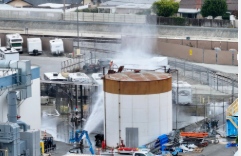
The California chemical tank explosion risk in Garden Grove turned critical on Friday. Firefighters first arrived Thursday at the GKN Aerospace site. A tank holding roughly 7,000 gallons of methyl methacrylate was overheating. Moreover, the tank was visibly bulging. That is a clear sign it could explode.
GKN Aerospace’s response team then arrived to inject a neutralizing agent. However, they found the tank valves blocked. They could not access the interior at all. Consequently, the most reliable option for stabilizing the tank disappeared entirely. Furthermore, evacuation orders went out across a wide zone. Officials could not predict where a fireball might land if the tank failed.
What methyl methacrylate is and why it matters
Methyl methacrylate makes plastics. It has a very low boiling point. Moreover, it overheats easily and turns to gas quickly under pressure. Furthermore, inhaling it is toxic. It irritates the respiratory system and can damage other organs.
Chemical plants normally rely on multiple fail safes for situations like this. However, the blocked valves removed those options at GKN Aerospace. Consequently, pressure kept building inside the tank. There was no safe way to release it. Additionally, experts warned that the chemical could shoot outward and create a toxic cloud over the surrounding area.
Faisal Khan leads the chemical engineering department at Texas A&M University. He said the worst case would be a tank rupture. That rupture could launch fire and debris into the air. Moreover, he compared it to a car collision where vaporized fuel creates a destructive fireball. However, he added that in this situation, the fireball could travel upward. It could then cause damage well beyond the immediate site.
How large could the explosion be
Experts have raised serious concerns about the scale of a potential blast. Joseph Shepherd studies chemical explosions at the California Institute of Technology. He said the 7,000 gallons of liquid could produce a very large fire. Moreover, special foams would be needed to extinguish it. Furthermore, a worst-case rupture could generate a fireball blasted into the air.
Khan estimated that if roughly half the material released at once, the fireball could be the size of a house. That estimate alarmed community members and officials alike. Additionally, Craig Covey, the incident commander with the Orange County Fire Authority, described the potential blast in stark terms. He compared it to a railroad tank car explosion. Those explosions produce massive fireballs and send debris flying half a mile. Consequently, officials made the evacuation zone large enough to account for the explosion’s unpredictable direction.
Where things stand right now
By Friday evening, Covey reported that the tank temperature had stabilized. That gave responders more time to find a solution. Moreover, a drone was monitoring the tank continuously. Furthermore, Covey confirmed that if the temperature reached a critical level, all staff would leave the area immediately.
State and local officials are working with national chemical experts. They are trying to prevent a catastrophic failure. However, no confirmed solution existed at the time of publication. Additionally, crews placed sand barriers around the site. Those barriers aim to stop chemical spills from reaching nearby storm drains and river channels.
Source: The New York Times
About the Author