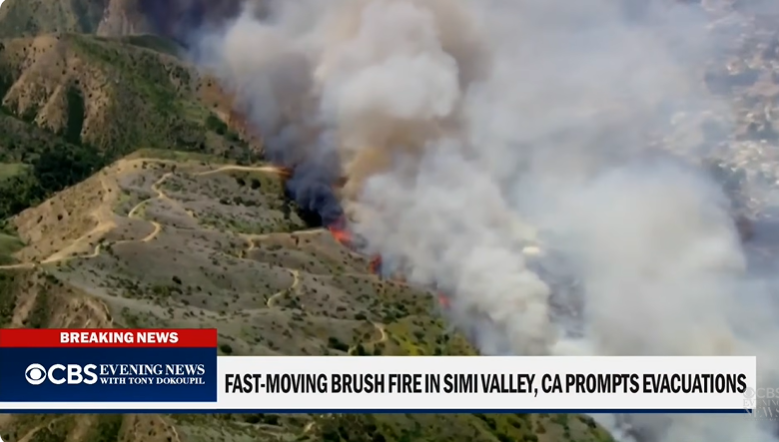
Courtesy;CBS News
The Sandy Fire in Simi Valley erupted Monday and moved quickly across the landscape of Ventura County, California. By Monday afternoon, the blaze had burned more than 800 acres. Furthermore, it had already destroyed several structures in its path. More than 28,000 residents now face mandatory evacuation orders. An additional 8,000 people are under evacuation warnings as the fire continues to grow.
Simi Valley sits approximately 40 miles northwest of Los Angeles. The region is no stranger to wildfire danger. Last year, devastating fires ripped through several Los Angeles communities and caused an estimated 440 deaths. The proximity of this new blaze to populated neighborhoods has prompted an urgent and large-scale response.
What is driving the fire’s spread
Dry conditions and strong winds are pushing the Sandy Fire forward at speed. Those conditions are among the most dangerous combinations for wildfire containment. They allow flames to jump quickly and make it difficult for aerial crews to operate effectively.
The fire is also burning close to several local schools, raising additional concerns about the safety of students and staff in the area. CAL FIRE confirmed that more than 550 firefighters are actively responding to the scene. That level of response reflects the seriousness of the threat and the speed at which conditions developed.
Direct Relief steps in to support local partners
Direct Relief, a humanitarian organization headquartered approximately 50 miles north of the fire in Santa Barbara, is closely monitoring the situation. The organization has already reached out to local healthcare partners in Ventura County to offer assistance and assess what medical resources may be needed.
On Monday, N95 respirators were picked up for distribution to outdoor workers in the affected area. Wildfire smoke poses a particularly serious respiratory risk to people working outdoors, as fine particulate matter from burning structures and vegetation can reach dangerous concentrations quickly. Healthcare partners are currently assessing what additional medical support the community will require.
Health risks extend beyond the flames
Fast-moving wildfires create health challenges that go well beyond the immediate danger of the fire itself. The full scale of health impacts often remains unclear in the early hours and days after a blaze breaks out. Requests for medical support typically increase in the days that follow as the displacement picture becomes clearer.
Disaster-related displacement carries its own set of health risks regardless of what caused the emergency. Evacuation interrupts continuity of care for people managing chronic conditions. It also disrupts access to medications, clean water and sanitation. Those disruptions can worsen existing health conditions and create new ones, particularly for elderly residents, children and people with underlying medical needs.
Direct Relief will continue monitoring the Sandy Fire closely. The organization remains in active contact with local healthcare providers and stands ready to respond as needs become clearer in the coming days.
Anyone wishing to support Direct Relief’s disaster response efforts can visit directrelief.org.
Source: Direct Relief
About the Author