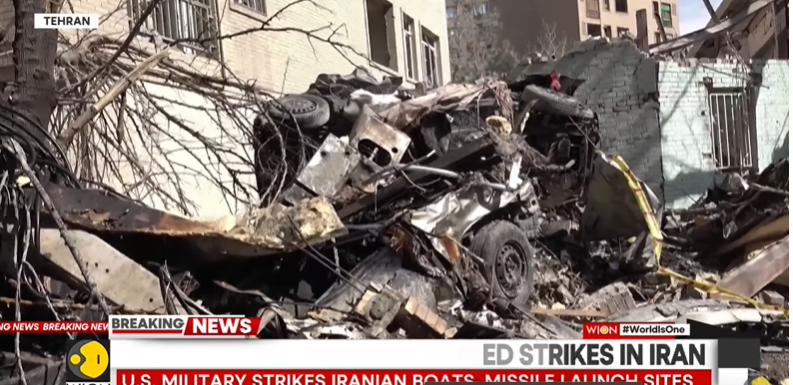
Courtesy: WION News
The U.S. military carried out a series of strikes near the Strait of Hormuz on Monday, May 25, targeting Iranian mine boats and missile launch sites. The strikes came despite a Pakistan-mediated ceasefire that has been in place since April 8. They also coincided with a high-level Iranian delegation traveling to Doha, Qatar, to hold negotiations aimed at ending the broader conflict.
U.S. Central Command said the strikes were carried out in self-defense to protect American troops from threats posed by Iranian forces. The command did not provide full details about the locations or scope of the operation. Iranian media subsequently reported explosions in Bandar Abbas, a port city approximately 70 kilometers from the Strait of Hormuz in southern Iran. Several Islamic Revolutionary Guard Corps personnel were reportedly killed in the attack, according to Iranian sources.
What the US and Iran each said
U.S. Secretary of State Marco Rubio, speaking to reporters while traveling in Jaipur, India, confirmed that the targets included boats attempting to lay mines near the Strait of Hormuz and missile launch sites. He stated that the strait, a critical global energy chokepoint that handles roughly one-fifth of global oil and gas flows under normal conditions, must be opened. He also tempered expectations around a swift diplomatic resolution, saying that finalizing a deal with Iran could take a few more days.
President Donald Trump addressed the situation in a lengthy post on Truth Social, describing the talks with Iran as going well but warning that further strikes would follow if negotiations collapsed. He framed the situation as a binary outcome: either a significant deal for all parties or no deal at all, followed by a return to more intense military action.
Iran’s Foreign Ministry offered a measured response. Spokesman Esmaeil Baghaei told reporters at a news conference in Tehran that the two sides had made meaningful progress and resolved a large portion of issues under discussion. However, he cautioned that progress does not mean a signed agreement is imminent. He also confirmed that Iran’s nuclear program is not currently part of the discussions, with the primary focus remaining on ending the war itself.
Iranian news agencies separately reported that Iran had downed a stealth drone using a new air defense system before the U.S. strikes took place. Iranian sources also told Al Jazeera that the IRGC had targeted a vessel at sea prior to the American military response, suggesting the exchange of hostilities was not entirely one-sided.
The diplomatic picture in Doha
Even as the strikes unfolded, diplomacy continued in parallel. A senior Iranian delegation arrived in Doha on Monday to meet with Qatari officials and work through the remaining obstacles to a permanent peace agreement. The delegation reportedly included Iranian Foreign Minister Abbas Araghchi, Parliament Speaker and lead negotiator Mohammad Bagher Ghalibaf and Central Bank Governor Abdolnaser Hemmati.
The talks in Doha represent the most substantive diplomatic engagement of recent weeks. Furthermore, Pakistani Prime Minister Shehbaz Sharif has been on a four-day visit to China, holding talks with President Xi Jinping and Premier Li Qiang. Those discussions have included the question of Iran’s willingness to reopen the Strait of Hormuz. However, the Trump administration indicated before the summit that it no longer requires China’s active involvement in that effort.
Trump also used the moment to link the peace negotiations to the broader Abraham Accords framework, suggesting that Saudi Arabia, Qatar and Pakistan should use the opportunity to normalize ties with Israel. The 2020 Accords previously normalized relations between Israel and the United Arab Emirates, Bahrain, Morocco and Sudan. Arab nations have broadly conditioned further normalization on progress toward a sovereign Palestinian state.
What the strikes mean for the peace process
The timing of the U.S. military action raises significant questions about the trajectory of negotiations. Al Jazeera’s Washington correspondent Alan Fisher noted that similar skirmishes have occurred since the ceasefire began in April. Trump did not treat those earlier incidents as ceasefire violations. Whether this latest exchange receives the same characterization remains unclear.
Fisher emphasized that very little information has come from the U.S. side about the full extent of Monday’s operation. That opacity makes it difficult to assess whether the strikes represent a contained incident or a more significant escalation. What is clear is that both military action and diplomatic engagement are proceeding simultaneously. Whether those two tracks can coexist long enough to produce a lasting agreement remains the central question of the conflict.
Source: Al Jazeera
About the Author