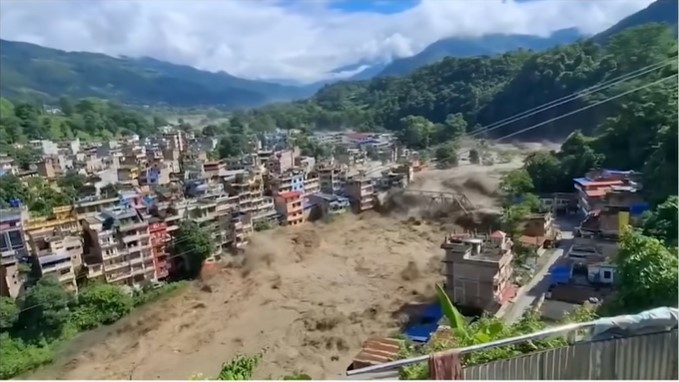
Photo credit: BBC News
The Nepal flash floods that tore through the Himalayan border region with Tibet on Wednesday have killed scores of people. The disaster also left hundreds more missing. It destroyed homes, roads, bridges and power infrastructure across the mountainous area.
Nepali police said late Wednesday that they had recovered 157 bodies. Officials expect that number to climb as search efforts continue.
What triggered the Nepal flash floods
The exact cause remains under investigation. However, Nepal’s foreign minister Shisir Khanal told parliament that an earthquake may have triggered an avalanche. That avalanche, in turn, may have caused the flooding. Researchers also noted a nearby seismic event around the same time that security footage captured.
One climate researcher pointed to an ice-rock avalanche as the likely trigger. Still, the exact cause has not been confirmed. A similar flood struck the same river last year. Reports eventually linked that earlier flood to a draining glacier lake.
For more context, this guide to glacial lake outburst floods explains how similar disasters form.
Hundreds of tourists unaccounted for after the Nepal flash floods
Nepal’s tourism ministry said 403 people were reported missing following the disaster. Of those, 341 were foreign nationals. Many were traveling through the region on popular pilgrimage routes and trekking trails.
Officials said 133 of the missing were Indian nationals on pilgrimage to Mount Kailash in Tibet. Hindus consider the site sacred. Dozens of other missing tourists came from the United States, Australia, Britain and Canada.
A Nepal police spokesperson confirmed that at least 28 police officials also remain unaccounted for, according to the Associated Press.
Damage extends across the border into Tibet
A mudslide also struck a land crossing in Gyirong county, across the border in Tibet. Chinese authorities reported three deaths there. More than 200 people remain missing as of Wednesday evening.
Meanwhile, Nepal’s energy ministry reported that the flooding affected 430 megawatts of electricity supply. Most of that came from hydroelectric projects. This figure represents more than 12 percent of the country’s total hydropower capacity.
Rescue efforts underway following the Nepal flash floods
Chinese officials dispatched roughly 600 firefighters to the affected area. They brought search and rescue dogs, life detection equipment and inflatable boats. China also allocated emergency disaster relief funds to support the response.
In Nepal, rescue helicopters struggled to reach the hardest-hit areas. River levels remained too high for helicopters to land safely. Officials said entire villages had vanished under the floodwaters.
Additionally, officials issued flood alerts in northern India. Rivers flowing down from the mountains threatened populated plains in neighboring states.
For ways to help, this list of vetted disaster relief resources offers a starting point.
What officials are saying
Chinese President Xi Jinping urged an all-out search effort for those still missing. He also called for stronger monitoring systems to help prevent future disasters.
A climate activist in Nepal described the scale of the destruction. He told reporters the floodwaters had wiped out entire villages. Nepal’s prime minister has since called for national unity as the death toll continues to rise.
Officials on both sides of the border say the investigation could take weeks. They still need to confirm the disaster’s precise cause and determine the full extent of the damage.
Source: NBC News
About the Author