Courtesy:ABC7 News

Diplomats from both nations met face-to-face in Islamabad in a historic but ultimately inconclusive attempt to reach a ceasefire agreement, with the central dispute over Iran’s nuclear ambitions proving impossible to bridge.
A historic meeting with no resolution
After more than two decades of diplomatic estrangement, American and Iranian officials sat across from each other in the Pakistani capital of Islamabad for a face-to-face meeting that many had considered unthinkable. The talks, brokered by Pakistan and held under the cover of a fragile two-week ceasefire, stretched through the night and into the early hours of Sunday, April 12, lasting a total of 21 hours before concluding without a peace agreement.
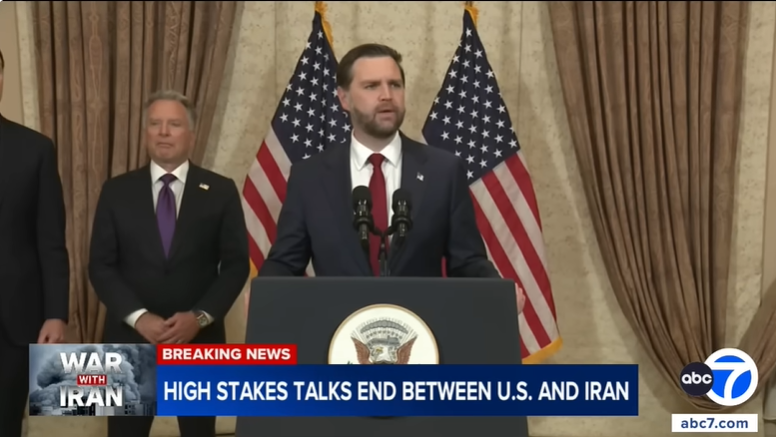
Vice President JD Vance, who led the American delegation, expressed gratitude to Pakistan’s Prime Minister Shehbaz Sharif and Field Marshal Asim Munir for their role as hosts and mediators, saying the outcome of the talks was no reflection on Pakistan’s considerable efforts to help both nations find common ground.
Who was at the table
The U.S. sent a high-profile team to Islamabad. Vance was joined by two key figures: 1. Special Envoy Steve Witkoff, who has been central to several of the administration’s international negotiations, and 2. Jared Kushner, President Donald Trump’s son-in-law and the architect behind the Abraham Accords. On the Iranian side, the delegation was led by Parliament Speaker Mohammad Bagher Qalibaf, a former commander in Iran’s powerful Revolutionary Guard.
The deal-breaker: nuclear weapons
At the heart of the breakdown was a single, non-negotiable demand from the American side a firm, long-term commitment from Iran to abandon any pursuit of nuclear weapons, including the infrastructure and tools that could fast-track their development. While Iran’s existing enrichment facilities had already been significantly damaged in earlier military strikes, Washington wanted something more than a temporary halt. It was seeking a durable, forward-looking pledge, and that is precisely what Iran refused to provide.
Vance made clear after departing the Serena Hotel that the U.S. came to Islamabad with flexibility and genuine willingness to negotiate, but that certain boundaries simply could not be moved. He described the proposal left on the table as the administration’s final and best offer, and said it now falls to Iran to decide whether to accept it.
Trump in the loop throughout
Despite being thousands of miles away, President Trump remained closely involved throughout the night. Vance confirmed he was in regular contact with the president, speaking with him close to a dozen times across the 21-hour stretch. The vice president also maintained an open line with Secretary of State Marco Rubio, Treasury Secretary Scott Bessent and Admiral Brad Cooper, the head of U.S. Central Command, ensuring the entire national security apparatus was aligned as talks progressed and stalled.
Iran pushes back
Iranian officials and state media told a very different story about why the talks collapsed. Sources connected to the Iranian delegation indicated that the U.S. arrived with demands they viewed as far beyond what any sovereign nation could accept, pointing specifically to conditions around removing nuclear materials from Iranian territory and the reopening of the Strait of Hormuz. Iranian state media described the American position as excessive and suggested the U.S. may not have entered the room with a genuine intent to reach a deal.
What happens next
Pakistan’s Foreign Minister Ishaq Dar urged both parties to honor the existing ceasefire and pledged that Islamabad would continue working to bring both sides back to the table. However, the two-week pause in hostilities that enabled the talks is set to expire, and Vance offered no clarity on whether it would be extended or what military posture the U.S. might adopt if it is not.
Now in its seventh week, the conflict has claimed thousands of lives and rattled global markets. The collapse of the Islamabad talks leaves both nations and a watching world in an increasingly uncertain position, with no new date for negotiations announced and the threat of renewed hostilities looming over every hour of silence.
Source: Reporting from 13ABC, The Daily Caller, Fox News, CNBC, Al Jazeera, and OPB.
About the Author