Emotional Artemis II Return Marks 4 Historic Milestones
Courtesy:NASA

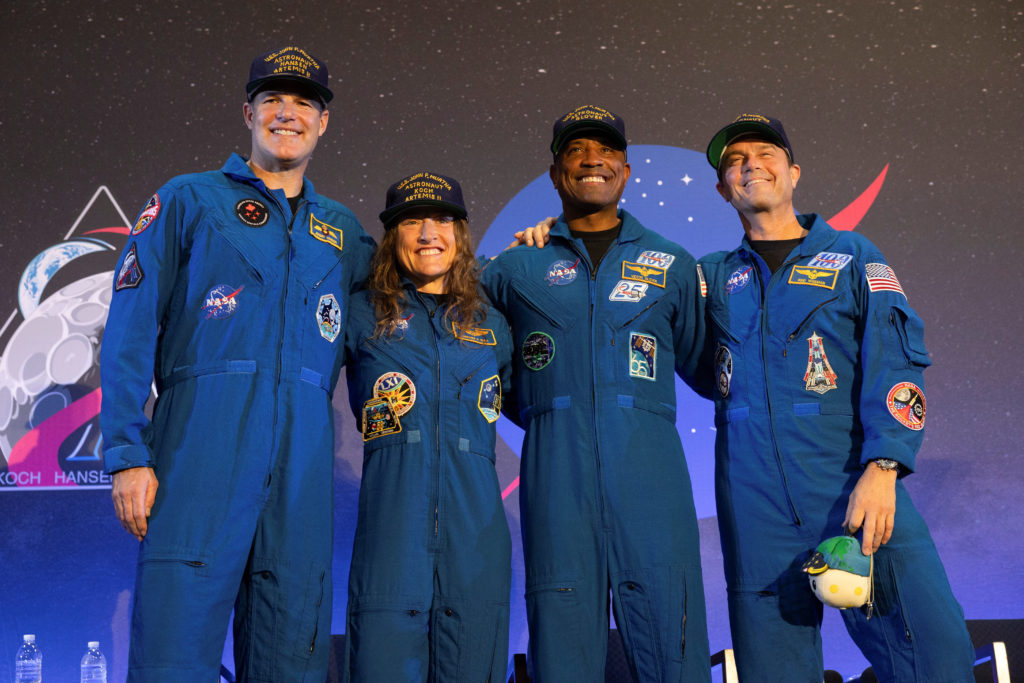
The four astronauts of Artemis II received an emotional welcome after completing a groundbreaking journey that pushed human space travel farther than it has gone in decades. The crew landed off the coast of San Diego before traveling to Houston, where they were greeted by colleagues, family members, and supporters at NASA’s Johnson Space Center.
Commander Reid Wiseman, pilot Victor Glover, mission specialist Christina Koch, and Jeremy Hansen of the Canadian Space Agency stood together on stage as they marked the end of a mission that lasted nearly 10 days.
Their return also aligned with the anniversary of Apollo 13, adding historical weight to an already significant moment for space exploration.
A record-breaking journey into deep space
During their mission, the Artemis II crew traveled farther from Earth than any human mission since the Apollo era. At its most distant point, the spacecraft reached more than 252,000 miles away, surpassing the record set during Apollo 13.
The astronauts performed a lunar flyby, looping around the far side of the moon before heading back to Earth. This trajectory allowed them to observe areas of the moon that have rarely been seen directly by humans.
The mission marked the first time astronauts traveled to the moon since Apollo 17 in 1972, signaling a major step forward in NASA’s renewed efforts to explore deep space.
A new perspective on Earth
One of the most memorable moments of the mission came from the crew’s view of Earth from deep space. From that distance, the planet appeared small against the vast darkness of space, offering a striking reminder of its fragility.
The crew also captured a rare “Earthset” image, showing Earth disappearing behind the moon’s surface. The image echoed the famous Earthrise photograph taken during Apollo 8, which helped shape public understanding of Earth’s place in the universe.
These visuals are expected to play a key role in how people connect emotionally to future space exploration efforts.
Challenges faced during the mission
Despite its success, the mission was not without its difficulties. The crew encountered a technical issue involving the spacecraft’s toilet system, a reminder that even advanced missions must deal with practical challenges.
NASA officials indicated that improvements are already underway, particularly as the agency prepares for longer missions that will include landing astronauts on the moon.
The ability to manage these issues in real time demonstrated the crew’s adaptability and the resilience of the mission’s design.
What comes next for NASA’s Artemis program
The success of Artemis II lays the groundwork for future missions under NASA’s Artemis program. The next step, Artemis III, is expected to test key operations, including docking maneuvers in orbit.
That mission will help prepare for Artemis IV, which aims to land astronauts near the moon’s south pole by 2028.
These efforts are part of a broader strategy to establish a sustained human presence on the moon and eventually support missions to Mars.
A moment of unity and reflection
As the astronauts reunited with their families and colleagues, the homecoming carried a sense of both accomplishment and anticipation. The event drew a wide audience, including engineers, astronauts, and officials who played a role in making the mission possible.
The Artemis II crew’s journey not only pushed the boundaries of space travel but also offered a renewed sense of purpose for future exploration. Their experience highlights both the risks and rewards of venturing beyond Earth, as humanity prepares for its next chapter in space.
Source: The Guardian
About the Author

Praise Swint
Wpseo_editor
Praise Swint is a contributor at Revelence, covering stories across news, entertainment, and culture.