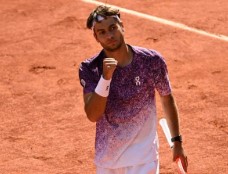
The French Open men’s final 2026 began exactly as the bookmakers predicted. Alexander Zverev dominated the opening set against Flavio Cobolli, winning it 6-1 with a triple break to establish immediate command. Moreover, the German second seed looked like a player destined to claim his first Grand Slam title with minimal resistance. Furthermore, Cobolli looked frazzled and scrambled through much of that opening set, unable to find his range or his rhythm against a player at the peak of his powers.
However, the match changed in the second set. Cobolli steadied himself and began executing from the baseline with far greater patience and precision. Additionally, he found the forehand laser that defines his best tennis. Consequently, the Italian tenth seed took the second set 6-4 to level the match and announce that this final would not end quickly or easily.
Set by set breakdown of a compelling final
The French Open men’s final 2026 has produced contrasting passages of play that reflect both players’ styles and strengths. Here is how each set unfolded at Court Philippe-Chatrier:
First set Zverev 6-1 Cobolli. The German triple-broke Cobolli and looked entirely dominant throughout. Cobolli struggled with his serve and could not establish any baseline patterns against Zverev’s relentless pressure.
Second set Cobolli 6-4 Zverev. Cobolli found his game and broke Zverev once in a set that showed the Italian’s capacity to build points methodically from the back of the court. His backhand improved significantly and his forehand began causing real problems.
Third set Zverev 6-4 Cobolli. Zverev reasserted control with outstanding serving. He went 13 out of 13 on first-serve points during the set and broke Cobolli at a key moment to edge back in front and take a two sets to one lead.
Fourth set Cobolli broke Zverev at the start to lead 1-0. Zverev double-faulted twice to give Cobolli two break points and the Italian converted. He then consolidated the break to lead 2-0 and the match is alive heading into the crucial final stages.
What the statistics say about each player’s chances
The serving numbers tell an important story in the French Open men’s final 2026. Zverev has been dominant on his serve throughout the match, facing break points in only one game across the entire contest. Moreover, his first-serve percentage and the power he generates on that shot have made it extremely difficult for Cobolli to establish any kind of rhythm on the return. Furthermore, when Zverev gets his first serve in, Cobolli has very few answers.
Cobolli’s serving has been his main vulnerability. His first-serve percentage sat at just 54 percent through the first three sets. Moreover, analysts covering the match noted that figure typically drops as a match extends and fatigue increases. Furthermore, at 54 percent, Cobolli has been giving Zverev regular opportunities to pressure his serve and extend rallies. Consequently, if Cobolli cannot improve that number in the fourth and potentially fifth set, it could prove decisive.
The forehand battle has been key throughout. Cobolli produces a genuinely dangerous inside-in forehand when he gets positioned correctly behind it. Additionally, Zverev’s forehand has been slightly less reliable than his backhand, which Cobolli exploited deliberately in the fourth set by going crosscourt repeatedly before testing that wing. Consequently, the tactical chess match at the baseline will likely decide who wins the Coupe des Mousquetaires trophy.
What is at stake for both players
The French Open men’s final 2026 carries enormous personal significance for both competitors. Neither Zverev nor Cobolli has ever won a Grand Slam title. Zverev has reached multiple Grand Slam finals before but has yet to convert one into a championship. Moreover, at 29, this represents another significant opportunity for him to finally claim the major title that has eluded him. Furthermore, a loss here against an Italian player ranked significantly below him would sharpen the questions around his ability to close out the biggest moments.
Cobolli’s story is different. At 23, the Italian reaches his first Grand Slam final as a relative newcomer to this stage. Moreover, winning Roland Garros in his debut appearance at a major final would rank among the most remarkable achievements in recent French Open history. Furthermore, his willingness to break Zverev at the start of the fourth set when the pressure was greatest shows a composure that has grown throughout the tournament.
Source: The Athletic / Live Team
About the Author