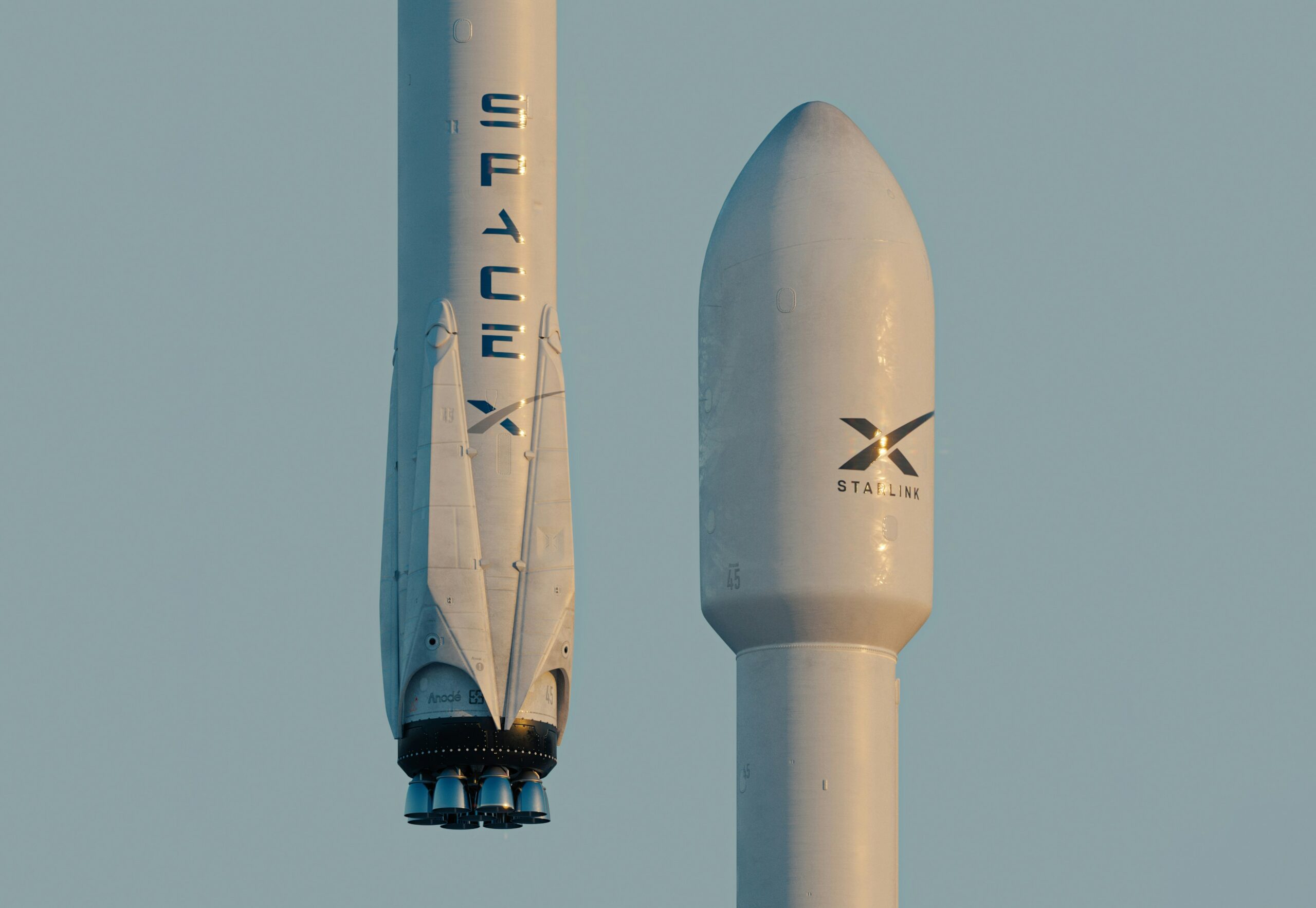
Photo by Anirudh on Unsplash
SpaceX lifts off with Starfall, its intriguing and secretive new reentry capsule
As the sun rose over Florida’s Space Coast on Tuesday morning, SpaceX’s Falcon 9 rocket climbed into the sky carrying one of the company’s most mysterious payloads to date. The mission, known as the Starfall Demo, marks the debut flight of SpaceX’s new uncrewed reentry capsule called Starfall. Liftoff from Space Launch Complex 40 at Cape Canaveral Space Force Station occurred at 6:53 a.m. EDT, right on schedule under near-perfect weather conditions. The 45th Weather Squadron had forecast a 95% chance of favorable conditions, with only minor concerns about cumulus clouds.
A secretive mission with big ambitions
SpaceX kept details of the Starfall mission unusually close to the chest. The company cut off its public-facing launch timeline after the booster landing and chose not to show views of the upper stage or the Starfall capsule during its broadcast. It has also not confirmed how many spacecraft flew on this mission.
An environmental assessment published by the Federal Aviation Administration in May offered some of the clearest public details available. According to that document, SpaceX sought to perform two Starfall reentries to demonstrate capabilities for future cargo transport through space. Whether this particular flight included more than one capsule remains unclear.
What we know about the Starfall capsule
The FAA document describes Starfall as a cylindrical capsule roughly 2.5 feet tall with a diameter of just over 10 feet. Each capsule weighs approximately 4,600 pounds and can carry up to 2,200 pounds of payload. The capsules can launch on either a Falcon 9 rocket or a Starship-Super Heavy vehicle and can reach either low Earth orbit or fly on a suborbital trajectory.
Starfall does not carry a main propulsion system. Instead it uses an attitude control system powered by inert gas to orient itself in space. That means the capsule can adjust its positioning but cannot perform its own de-orbit burn. Recovery takes place in the Pacific Ocean, following a similar approach to SpaceX’s Dragon spacecraft.
The capsule consists of 2 primary components. The top plate is an aluminum structure partially wrapped in thermal protection material, weighing around 1,400 kilograms. The heat shield, made of carbon fiber wrapped in thermal protective material, weighs approximately 700 kilograms. After reentry, the top plate separates to deploy a series of parachutes, including a drogue, a pilot and a main landing parachute, all connected to four reinforced attachment points on the vehicle.
The bigger picture: space manufacturing at scale
The ambitions behind Starfall extend well beyond a single demo flight. The FAA document outlines a vision for point-to-point delivery of critical cargo on rapid timelines, as well as the creation of a self-sustaining commercial in-space manufacturing market. SpaceX sees Starfall as a way to offer access to microgravity environments, extended time in orbit and safe return from space as a service.
The document goes further, describing Starfall as a potential successor to the International Space Station for manufacturing purposes. The idea is to take the kinds of experiments the ISS has run for decades and scale them into a functioning commercial economy in orbit. SpaceX’s IPO roadshow materials included a graphic suggesting a satellite bus capable of holding up to 4 Starfall capsules at once, labeled as supporting in-orbit manufacturing.
Booster lands for the 628th time in SpaceX history
The Falcon 9 first stage booster used for this mission, designated B1078, completed its 29th flight. Nearly nine minutes after liftoff it touched down on the drone ship named A Shortfall of Gravitas in the Atlantic Ocean. It marked the 157th landing on that vessel and the 628th successful booster landing in SpaceX history.
Source: Spaceflight Now
About the Author