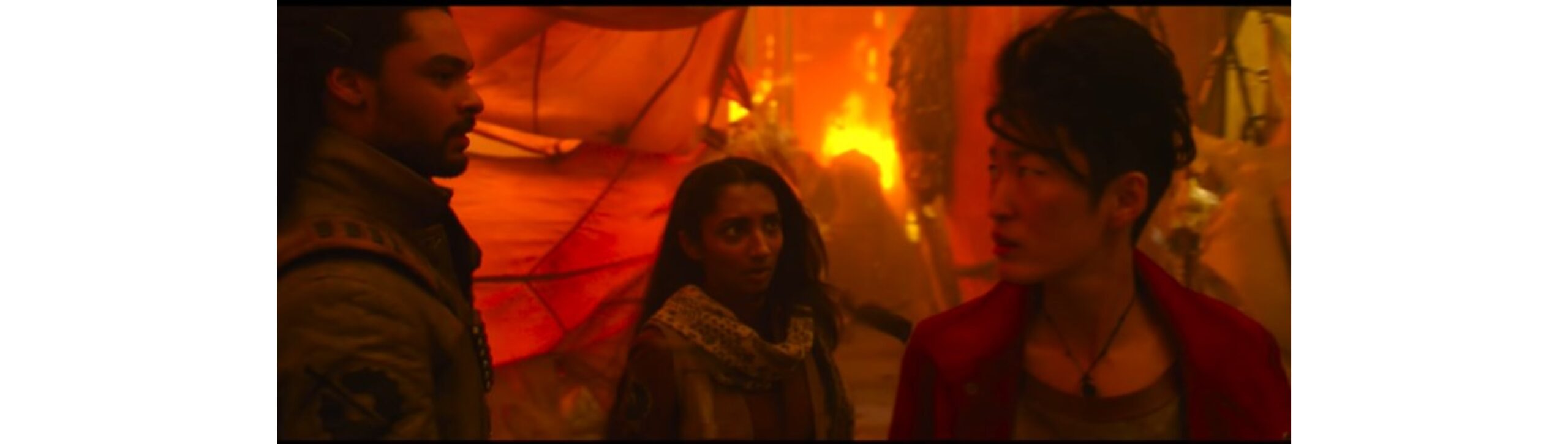
Photo credit: Universal Pictures
Mortal Engines takes place thousands of years after a catastrophic war destroyed most of human civilization. To survive in a barren world stripped of its resources, many cities transformed into giant moving machines. These traction cities hunt and consume smaller towns for fuel and materials. London stands as the largest and most powerful of them all.
At the center of the story is Thaddeus Valentine, a respected historian and politician who secretly plans to use an ancient superweapon called MEDUSA to destroy Shan Guo, a massive fortified settlement, and secure London’s permanent dominance. His daughter, Katherine Valentine, eventually uncovers his deception. As a result, she turns against him and works to stop the plan from the inside.
Who Hester Shaw is and why Shrike is hunting her
Hester Shaw has spent most of her life driven by one goal: revenge against Valentine. As a child, she witnessed Valentine murder her mother and left her permanently scarred. After that trauma, the cyborg soldier Shrike found and raised her. Known as a Stalker, Shrike is a resurrected warrior rebuilt as a mechanical being with no remaining mortality.
Shrike genuinely cares for Hester in his own cold, mechanical way. However, his love takes a disturbing form. He wants to transform her into a Stalker like himself so they can stay together forever. Hester made him a promise long ago that she would eventually accept that fate. The film’s tension builds partly around whether that promise will be kept.
What happens during the attack on the shield wall
The scene takes place during the film’s final act as multiple storylines collide. London launches its attack on Shan Guo’s shield wall. Chaos erupts across both sides of the conflict. People scramble to evacuate as the situation spirals beyond anyone’s control. Katherine pursues a desperate confrontation with her father. She rejects him entirely in that moment, making clear that she can no longer support what he has become.
Meanwhile, Shrike tracks Hester down amid the chaos and finally catches her. He arrives as a terrifying presence, fully focused on claiming what he believes she owes him. However, something quickly becomes clear to him. Hester is no longer the revenge-consumed girl he once knew.
The emotional turning point between Hester and Shrike
Instead of fighting or running, Hester begs Shrike to spare Tom Natsworthy, the young man she has grown to love during their journey together. She puts herself between Shrike and Tom and pleads for his life, making it clear she will sacrifice herself if necessary. That act of selfless love stops Shrike in his tracks.
The realization hits Shrike in a profound way. Hester has found genuine human connection. She has developed the capacity for love and compassion that Shrike himself lost when he was transformed into a Stalker. He understands that forcing her to keep her promise would destroy the very thing that makes her worth caring about.
Why Shrike’s final act defines the scene
Shrike chooses to release her. He returns the pendant that once belonged to Hester’s mother, an object she has carried as a connection to her lost past and the family Valentine destroyed. He tells her he releases her from her promise. With that, he lets her go entirely.
The gesture transforms Shrike completely. He begins the film as a relentless and terrifying pursuer. He ends it as a tragic figure whose final act is one of love and sacrifice. He gives up the future he wanted for himself so Hester can live the human life she has chosen. Furthermore, he does it without bitterness or violence. He simply lets her remain what he can never be again.
What the scene means for the film’s themes
The moment between Hester and Shrike captures the emotional heart of Mortal Engines. The film consistently asks whether the past should define the future. Valentine clings to ancient weapons and old hierarchies. The traction cities are themselves machines built to consume history for survival. Hester spends most of the story defined by the wound Valentine gave her as a child.
Shrike’s release of Hester represents the film’s answer to that question. Love, forgiveness and the willingness to let go matter more than any promise made in pain. The scene combines intense action with genuine emotional weight, making it the most affecting sequence in the film and the one that gives its themes their fullest expression.
Source: Mortal Engines (Universal Pictures, 2018) / scene analysis
About the Author