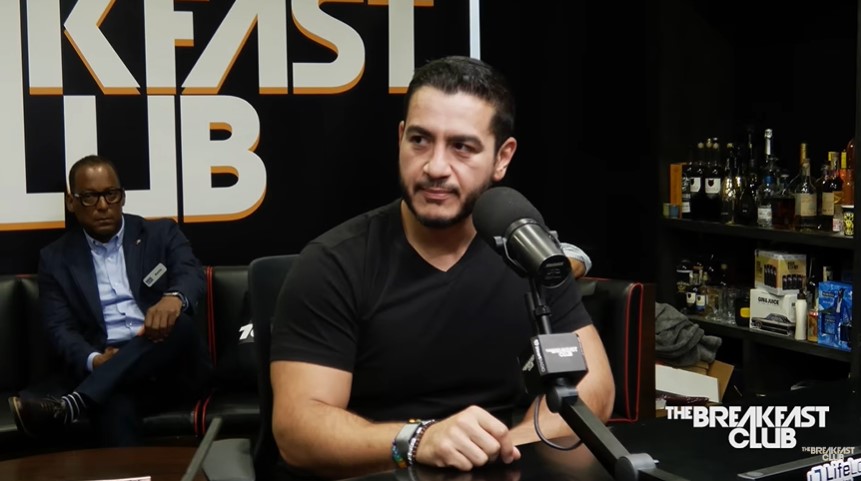
Photo credit: The Breakfast club
Abdul El-Sayed brought his political agenda to The Breakfast Club for a wide-ranging conversation about capitalism, the Democratic Party and a recent controversy involving his comments about the Temple Israel attack.
Charlamagne Tha God, DJ Envy and Jess Hilarious interviewed the Michigan physician and U.S. Senate candidate on the latest episode.
The conversation covered El-Sayed’s economic views and his criticism of both major political institutions. He also addressed questions surrounding his campaign and comments that drew criticism from members of Michigan’s Jewish community.
Abdul El-Sayed Says the U.S. Has a Corporate Problem
El-Sayed argued that the U.S. economy no longer reflects the form of capitalism many Americans imagine.
Instead, he described the current system as “corporatism,” where powerful companies can eliminate competition and gain political influence.
El-Sayed compared his approach to medicine. As a physician, he said he looks at symptoms before identifying the underlying problem.
He applied the same idea to economic policy.
Rather than defending political slogans, El-Sayed said progressives should focus on understanding what has gone wrong and finding practical solutions.
His argument centers on competition, economic power and the influence corporations can have on government decisions.
Abdul El-Sayed Criticizes the Democratic Party
El-Sayed also offered a sharp assessment of the Democratic Party.
He linked the party’s growing reliance on corporate donors to the decline of organized labor. According to El-Sayed, weakening unions left Democrats searching for another reliable source of political funding.
He argued that this shift pushed the party closer to corporate interests.
El-Sayed said Democrats consequently lost touch with material concerns affecting working-class voters.
He contrasted those concerns with what he described as an increased focus on symbolic political gestures.
For El-Sayed, issues such as health care represent concrete guarantees that can directly affect people’s lives.
Abdul El-Sayed Addresses Hasan Piker Controversy
The Senate candidate also discussed questions about his association with political commentator Hasan Piker.
El-Sayed said he does not believe in dismissing people simply because of controversial statements made by others.
He said he evaluates individual comments instead of labeling entire people or groups based on one person’s views.
El-Sayed also argued that attempts to connect his campaign to Piker’s statements serve as a political distraction.
He maintained that voters should focus on his policy positions and his campaign rather than the views of outside commentators.
Abdul El-Sayed Apologizes Over Temple Israel Comments
One of the most serious parts of the interview involved El-Sayed’s earlier remarks about the attack at Temple Israel in Michigan.
Some members of the state’s Jewish community interpreted his comments as excusing or minimizing the violence.
During The Breakfast Club interview, El-Sayed apologized and said that interpretation did not reflect his intention.
He emphasized that he values the safety of Jewish families in the same way he values the safety of his own children.
El-Sayed also drew a distinction between criticism of Israeli government policy and judgments about Jewish or Muslim communities.
He argued that political disagreements involving Israel should not lead to broad assumptions about either community.
Michigan Senate Race Faces More Scrutiny
El-Sayed’s appearance comes as he campaigns for a U.S. Senate seat in Michigan.
His interview gave him an opportunity to explain several of the issues that have shaped his campaign and generated public debate.
Economic inequality, health care, corporate influence and the direction of the Democratic Party remain central to his political message.
At the same time, the Temple Israel controversy has added another layer to questions about how he approaches sensitive political issues.
El-Sayed used the interview to directly address those concerns while outlining the principles behind his campaign.
Abdul El-Sayed Puts Policy at the Center
Throughout the conversation, El-Sayed returned to the idea that voters should judge candidates by the policies they support.
His comments on capitalism, corporate influence and health care reflect a campaign focused heavily on economic and material issues.
His response to the Temple Israel controversy also showed an effort to draw clear lines between criticism of government policy and the treatment of entire communities.
The interview gives voters another look at El-Sayed’s political philosophy as the Michigan Senate race develops.
Source: The Breakfast Club
About the Author