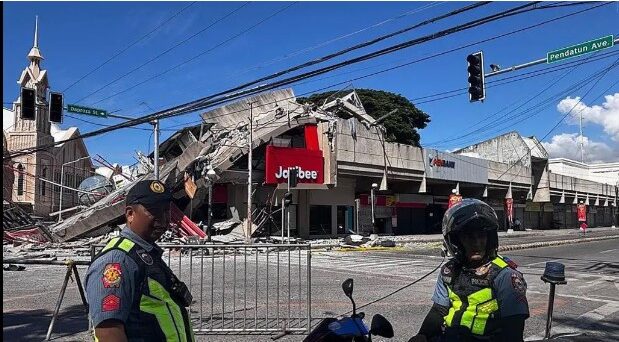
Courtesy:BBC News
The Philippines earthquake 7.8 magnitude event hit at 7:37 a.m. local time on June 8, 2026. The epicenter sat off the coast of General Santos City in Mindanao, the country’s main southern island. Moreover, the Philippine Institute of Volcanology and Seismology confirmed the quake reached a depth of 10 kilometers. Furthermore, police confirmed that at least three people died and five others suffered injuries in the initial aftermath.
The quake damaged approximately 37 buildings, mostly commercial, according to police estimates. Additionally, tsunami warnings went out across several countries including the Philippines, Indonesia, and Japan in the immediate hours after the tremor. Consequently, thousands of residents fled to higher ground as authorities assessed the threat across the region.
Tsunami waves recorded across Mindanao and neighboring countries
Tsunami waves following the Philippines earthquake 7.8 magnitude event reached six areas along Mindanao’s southern coast. The highest wave recorded measured 1.4 meters. Moreover, the Philippine Institute of Volcanology and Seismology confirmed waves between 7:42 and 8:45 local time. Furthermore, tsunami warnings remained in place for the Philippines as instruments continued recording activity.
Waves also reached Indonesia and Palau. In Northern Sulawesi province, waves measuring 0.3 feet and 2.7 feet hit multiple locations. Additionally, the US Geological Survey recorded a 1.5 foot wave at Davao City, nearly 200 kilometers from the epicenter. Consequently, Indonesian authorities initially issued a warning before lifting it after waves were measured and assessed.
Japan warned that tsunami waves up to 1 meter high could hit its southern Okinawa islands and prefectures along the Pacific coast. However, authorities later assessed the threat as limited. Moreover, Australia cancelled its tsunami watch after the Joint Australian Tsunami Warning Centre initially flagged a potential threat to Christmas Island and the Northern Territory. Furthermore, New Zealand authorities said the earthquake was unlikely to generate a tsunami threatening their shores. Consequently, regional warnings were progressively lifted as the situation stabilized.
Devastation in General Santos City and rescue operations underway
General Santos City suffered significant structural damage from the Philippines earthquake 7.8 magnitude tremor. Videos shared by Philippine authorities showed collapsed shopfronts and at least two branches of Jollibee, the beloved national fast food chain, collapsing during the quake. Moreover, a resident captured dramatic footage of one Jollibee outlet reduced entirely to rubble in real time. Furthermore, shattered glass and collapsed commercial structures appeared across multiple blocks of the city center.
General Santos Airport suspended all operations immediately after the quake for safety assessments. The Civil Aviation Authority of the Philippines confirmed the suspension. Additionally, the Transport Department said operations at other airports across Mindanao remained normal. Consequently, travel disruptions were largely contained to the General Santos hub.
The Philippine Red Cross activated its highest alert level and deployed teams to the ground. Members began assessing structural damage and coordinating evacuation and relief operations across the affected areas. Moreover, power was cut initially across parts of the city but restored relatively quickly. Furthermore, internet connectivity remained erratic in several areas, complicating communications between rescue teams and central authorities. Consequently, real-time updates from some parts of the region were limited in the hours immediately following the quake.
Aftershocks continue as government responds
The Philippines earthquake 7.8 magnitude event triggered 138 aftershocks by 11:00 a.m. local time, according to the Philippine Institute of Volcanology and Seismology. Those aftershocks ranged in magnitude from 1.3 to 6.7. Moreover, the strongest aftershocks added to structural concerns for already damaged buildings. Furthermore, authorities warned residents not to re-enter homes or commercial buildings showing any signs of damage.
Philippine President Ferdinand Marcos Jr. responded quickly to the disaster. He directed all relevant government agencies to act immediately and urged people in coastal areas to move to higher ground. Moreover, the national disaster management agency deployed teams and began monitoring casualty reports across affected areas. Additionally, the Philippine Red Cross coordinated with government agencies to ensure evacuation centers were operational. Consequently, the government response moved quickly given the severity of the initial tremor.
General Santos City is known as the country’s tuna capital due to its bountiful southern port supplies. Moreover, it is also the hometown of Manny Pacquiao, the world boxing champion who went on to serve as a congressman and senator. Furthermore, the city’s profile makes the earthquake’s impact a matter of national attention well beyond the immediate humanitarian emergency.
Source: BBC News
About the Author