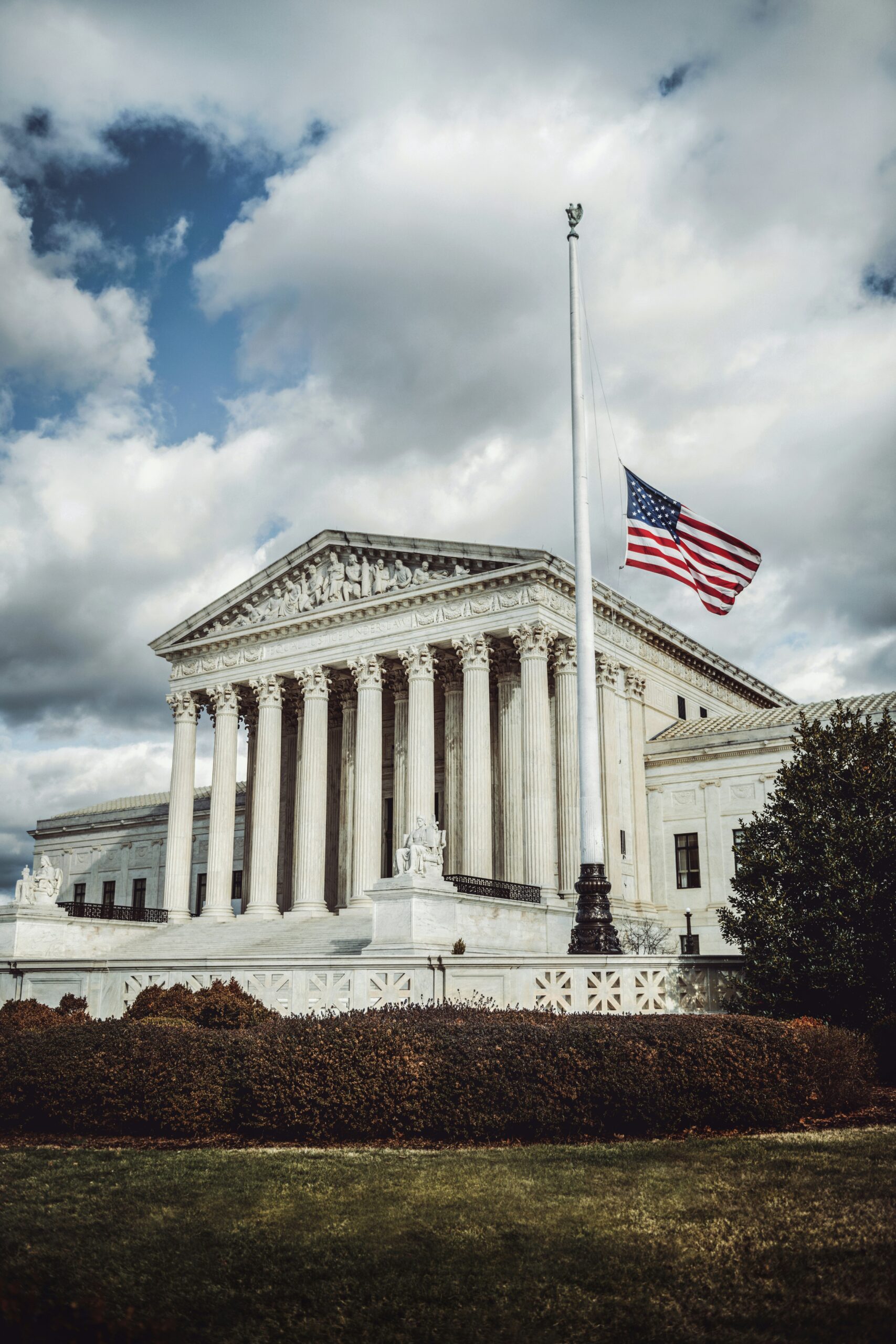
Photo by Tim Mossholder on Unsplash
The Supreme Court is set to rule Tuesday on the constitutionality of President Donald Trump’s order on birthright citizenship. The order declares that children born to parents who are in the United States illegally or temporarily are not American citizens. The decision arrives on the final day of a Supreme Court term that has centered heavily on Trump’s expansive claims of presidential power, a term the court has largely decided in his favor.
On Monday, the court delivered Trump a major win by upholding his ability to fire independent federal agency heads at will. The one notable exception involved Federal Reserve Governor Lisa Cook, who will retain her position while she continues fighting Trump’s attempt to remove her over mortgage fraud allegations she has denied.
Beyond the birthright citizenship case, the court is also expected to rule on cases from West Virginia and Idaho concerning whether states can prohibit transgender girls and women from competing on public school and college sports teams. Additionally, a separate case addressing limits on political party spending in coordination with congressional and presidential candidates remains pending.
Most Americans support birthright citizenship, but views diverge on specifics
A survey conducted in April by the Associated Press-NORC Center for Public Affairs Research surveyed more than 2,500 U.S. adults and found that roughly two-thirds support automatic citizenship for children born in the United States. That support drops significantly among Republicans, with only 44% in favor.
The survey also revealed considerable nuance in public opinion. Support for automatic citizenship reaches 75% when the question specifically involves children born to parents legally present on work visas. However, support drops to roughly half when the question shifts to children born to parents who are in the country illegally.
The court sided with states on late-arriving mailed ballots
In a separate ruling issued Monday, the court decided in a 5-4 vote that states can continue counting mailed ballots that arrive after Election Day, provided those ballots were postmarked on time. The decision rejected a Republican-led challenge to laws currently in place in more than half of all states and the District of Columbia.
The ruling spares election officials from having to adjust their ballot processing rules just months before the 2026 midterm congressional elections. In slightly more than half of the states with these forgiving deadlines, the extended timeline applies specifically to ballots cast by military and overseas voters.
Oral arguments revealed deep skepticism toward the government’s case
During oral arguments earlier this year, several justices, including some conservatives, appeared unconvinced by the administration’s legal reasoning. Justice Amy Coney Barrett pressed Solicitor General D. John Sauer directly on how the policy would handle abandoned infants and cases where a child’s parentage is unknown. When Sauer attempted to point to existing federal statute, Barrett redirected him back to the constitutional question at the heart of the case.
Justice Ketanji Brown Jackson similarly pushed for practical clarity, asking pointed questions about how citizenship determinations would actually function in real time, including in delivery rooms immediately after birth. Chief Justice John Roberts expressed skepticism that narrow, unusual exceptions to traditional citizenship rules could support the broad argument the administration was making about a much larger population of people in the country illegally. Among the justices, Clarence Thomas appeared most sympathetic to the administration’s position.
How birthright citizenship works around the world
Outside the Americas, most countries follow the principle of jus sanguinis, or right of blood, under which a child’s citizenship is inherited from their parents regardless of where the birth takes place. No European Union member state currently grants automatic, unconditional citizenship to children born to foreign nationals within their borders.
American legal tradition, by contrast, descends largely from English common law, which historically recognized jus soli, or right of soil, granting citizenship based on a child’s place of birth. The United Kingdom itself moved away from that principle with the British Nationality Act of 1981. Under current UK law, individuals born in the country only receive citizenship if at least one parent is a British citizen or holds settled status.
Monday’s ruling dramatically expanded presidential authority
Monday’s decision on federal agencies marked a significant shift in the balance of power between the presidency and independent regulatory bodies. With the exception of the Federal Reserve, given its distinct role in setting interest rates, the court ruled that presidents now have broad authority to fire agency heads at will. That ruling came despite federal laws requiring cause for such dismissals and despite a 91-year-old precedent that had previously limited executive authority in this area.
The court’s six conservative justices formed the majority in that decision, effectively setting aside the long-standing unanimous ruling in Humphrey’s Executor, which had historically protected agency board members from removal in order to preserve decision-making free from political influence. Chief Justice Roberts wrote for the majority that such removal protections are contrary to the separation of powers enshrined in the Constitution.
What comes next
With the birthright citizenship ruling expected Tuesday alongside decisions on transgender athletes and campaign finance limits, the court is closing out a term that has reshaped the boundaries of executive power in significant and lasting ways. The justices will read summaries of their remaining opinions starting at 10 a.m. ET, typically in ascending order of seniority, meaning Chief Justice Roberts, who may be writing the birthright citizenship opinion, would likely speak last.
Source: The Associated Press
About the Author