

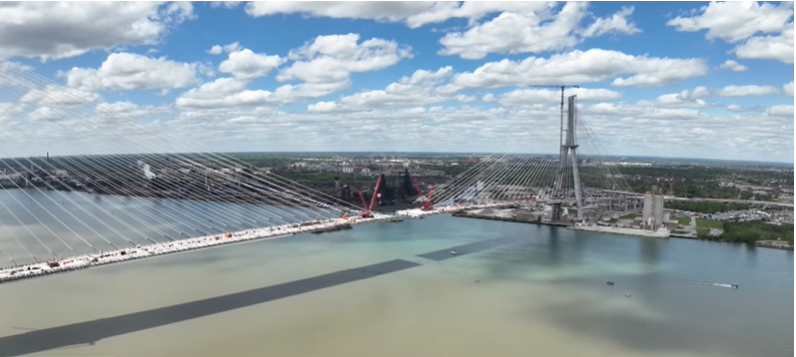
Courtesy:CBC News
Courtesy:CBC News
President Donald Trump issued a warning Monday evening that could delay the opening of the Gordie Howe International Bridge between Detroit and Windsor, Ontario. He claimed the United States must receive what he described as fairness and respect from Canada before allowing the multibillion-dollar project to operate.
The bridge, under construction since 2018 and financed by Canada, has been considered a milestone in U.S.-Canada infrastructure cooperation. It was originally promoted as a symbol of partnership between the two nations. Now, Trump’s comments suggest potential political and economic challenges ahead for the region.
Ownership and funding
The Gordie Howe International Bridge is jointly owned by Canada and the state of Michigan, with Canada covering the construction costs. Michigan lawmakers previously declined to contribute financially more than a decade ago. The U.S. is expected to operate a customs plaza on its side, with staffing provided by federal authorities, which is a potential point of leverage for the Trump administration.
Officials in Michigan, including the governor’s office, emphasize the project as a model of bipartisan and international collaboration. The bridge is designed to enhance trade, provide redundancy to existing crossings, and support economic growth for both countries.
Economic implications
The bridge is projected to become the busiest land port between the U.S. and Canada, with an estimated 6,000 daily commuters crossing from Ontario to Detroit. It is expected to relieve congestion at the Ambassador Bridge and Detroit-Windsor Tunnel while streamlining freight transport.
Delaying the opening could have consequences for Michigan’s economy, affecting industries that rely on cross-border supply chains, including auto manufacturing, logistics, and retail. Disruption could increase costs for businesses and slow delivery of parts and goods through one of North America’s busiest trade corridors.
Trade and diplomatic effects
Trump’s threat highlights tensions over trade issues, including restrictions on U.S. alcoholic beverages, tariffs on dairy products, and Canada’s reported economic dealings with China. Blocking the bridge could escalate negotiations and affect bilateral relations.
The bridge has long been positioned as a commercial and diplomatic asset, connecting two countries with deeply integrated economies. Its delay could complicate trade flows and have ripple effects for businesses and communities on both sides of the border.
Infrastructure and commute benefits
Once operational, the bridge will rise 150 feet above the Detroit River and span 720 feet, making it the largest port along the U.S.-Canada border. It will provide direct access to I-75 and I-96 in Detroit and Ontario Highway 401, improving passenger and freight traffic.
This infrastructure is designed to handle commercial trucks and passenger vehicles alike, creating a safer, faster, and more efficient crossing. Construction employed union workers from both countries, reflecting collaboration in labor and planning.
Political and regional reactions
Michigan lawmakers, local officials, and industry leaders have voiced concern about potential delays. The bridge had previously received support from both Republican and Democratic leaders as a long-term economic investment. Automotive companies and supply chains depend on timely completion.
Delays could impact local jobs, trade volumes, and regional growth. The statement by Trump signals a shift in federal support, introducing uncertainty as officials prepare to ensure the bridge opens safely and efficiently.
The Gordie Howe International Bridge represents years of planning, cross-border cooperation, and economic investment. While the exact outcome of Trump’s threat remains uncertain, the infrastructure project underscores the importance of trade, transportation, and collaboration between the United States and Canada.
Source: The Detroit News
About the Author








1 thought on “Trump’s threat could delay Detroit-Windsor bridge launch”