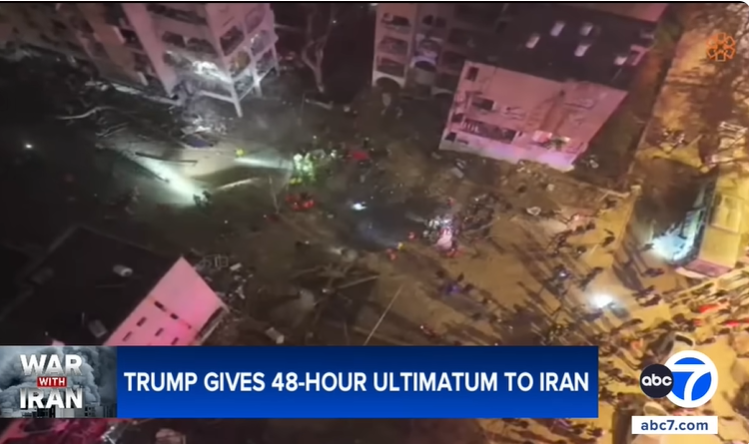
Courtesy:ABC7
The war between the United States, Israel, and Iran entered its fourth week on Sunday with a series of developments that raised the specter of catastrophic escalation on multiple fronts simultaneously. President Trump issued a 48-hour ultimatum threatening to destroy Iranian power plants if the Strait of Hormuz was not fully reopened. Iran responded with defiance, launched fresh missile strikes on Israeli cities near the country’s main nuclear research facility, and warned that any attack on its energy infrastructure would trigger retaliatory strikes against vital facilities across the entire region. More than 2,000 people have been killed since the conflict began, mostly in Iran.
The stakes have never been higher, and there is no clear path toward resolution in sight.
Trump’s 48-hour ultimatum and what it could mean
President Trump posted on social media that the United States would obliterate Iran’s power plants infrastructure that millions of Iranian civilians depend on daily if the Strait of Hormuz was not fully and unconditionally reopened within 48 hours. He specified that strikes would begin with the largest plant first, a statement widely interpreted as a reference to the Bushehr nuclear power plant, Iran’s only operating nuclear facility.
The threat represented a significant and troubling shift. Just days earlier, Trump had publicly urged Israel to avoid targeting Iranian energy sites, warning that doing so would trigger an escalating cycle of counter-strikes across the Gulf. Nuclear power plants have been considered off limits in modern warfare for decades because of the obvious and catastrophic risk of environmental disaster. The Bushehr plant is fueled by Russian-provided uranium and monitored by the International Atomic Energy Agency.
Mike Waltz, the U.S. ambassador to the United Nations, defended the president’s position in Sunday morning television appearances, arguing that Iran’s thermal power plants were legitimate military targets because much of the country’s energy infrastructure is controlled by the Islamic Revolutionary Guards Corps.
Iran fires back with missiles and defiance
Iran’s response to the ultimatum was swift and unambiguous. Iranian military spokesman Ebrahim Zolfaghari warned that if energy infrastructure was attacked, Iran would target fuel, energy, information technology, and desalination facilities across the region used by Israel, the United States, and American allies. He added that the Strait of Hormuz would remain completely closed until any damaged Iranian power plants were fully rebuilt — a timeline that could extend for months or years.
Iran’s first vice president Mohammad Reza Aref dismissed Trump’s threats as a direct attack on the Iranian people themselves, arguing that striking civilian infrastructure constituted a clear violation of humanitarian principles and international law. Iran’s Parliament speaker warned that attacks on critical infrastructure would trigger an irreversible destruction of energy and oil facilities across the region and send already elevated global oil prices soaring even higher.
Iran also pushed back on claims that it had fully closed the Strait of Hormuz, with its permanent representative to the International Maritime Organization clarifying that the waterway remained open to friendly nations including China, India, and Pakistan.
Iranian missiles strike near Israel’s nuclear facility
Hours before Trump’s ultimatum, Iranian missiles penetrated Israeli air defenses and struck the cities of Dimona and Arad in southern Israel, injuring approximately 175 people, at least 10 of them seriously. Dimona sits just 8 miles from Israel’s main nuclear research installation, the Shimon Peres Negev Nuclear Research Center, one of the most heavily guarded sites in the country. Iran’s state broadcaster confirmed the strike was intended to target the nuclear facility, though the United Nations’ nuclear watchdog said it found no evidence of damage to the site.
The strikes marked the first time either Dimona or Arad had been directly hit in more than two years of regional conflict. Residents described scenes of extensive destruction, shattered windows stretching half a mile from impact sites, craters carved into residential courtyards, and apartment buildings set for demolition. Israel’s military acknowledged it had failed to intercept one of the missiles and opened an investigation.
Schools across Israel, which had only just been reopened in affected areas due to reduced missile fire, were immediately shuttered again following the strikes.
The broader war and its mounting human cost
The conflict has now spread well beyond its original theater in ways that are straining the entire international community. Israel’s defense minister ordered the military to accelerate the demolition of houses and bridges in southern Lebanon as part of an expanding campaign against Hezbollah, the Iran-backed armed group that has fired rockets and drones at Israel throughout the conflict. More than a million people have been displaced in Lebanon and over 1,000 have been killed, according to Lebanese government figures.
Iran attempted a missile strike on the joint U.S.-British military base at Diego Garcia in the Indian Ocean, 2,500 miles away, on Friday — a distance that surprised American officials and raised urgent new questions about the true range of Iran’s missile arsenal. One missile failed mid-flight and a second was shot down by a U.S. warship, but the attempt alone signaled that Iran’s reach extends further than many publicly stated estimates had assumed.
The United Arab Emirates reported 4 ballistic missile and 25 drone attacks from Iran on Sunday alone. A bulk carrier vessel off the coast of Sharjah reported an explosion from an unknown projectile, though all crew members were reported safe. Saudi Arabia intercepted a ballistic missile launched toward Riyadh.
Where the conflict stands and what comes next
Treasury Secretary Scott Bessent acknowledged on Sunday that gas prices, which have climbed approximately 50 percent since the war began, may remain elevated for an indeterminate period. He offered the hypothetical that a period of temporary elevated prices could be a worthwhile tradeoff for lasting peace in the Middle East but was unable to say whether relief would come in 30, 50, or 100 days.
Goldman Sachs has warned that if ships remain reluctant to transit the Strait of Hormuz, elevated oil prices could persist well into 2027. The International Energy Agency has described the current situation as the largest supply disruption in the history of the global oil market.
Israel’s military chief of staff told the Israeli public on Saturday that they were midway through the war with Iran and would still be fighting during the Passover holiday next week. Iran has been under a complete internet blackout for 23 consecutive days. More than 2,000 people have been killed across the region since the conflict began on February 28, the majority of them in Iran.
The 48-hour clock on Trump’s ultimatum is running.
Source: The New York Times
About the Author