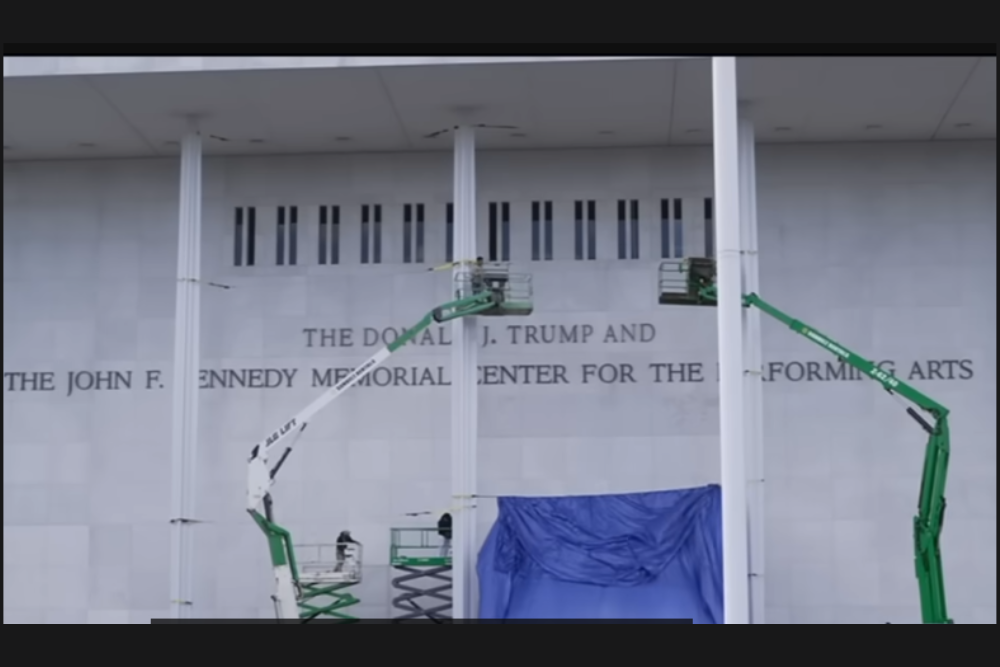
Photo screenshot: ABC7 YOUTUBE/Kennedy Center to close for 2 years for renovations in July, Trump says
A federal judge ruled today that President Donald Trump acted illegally when he added his name to the Kennedy Center, ordering officials to remove all signage and references to the renamed institution within two weeks. US District Judge Christopher Cooper concluded that the law establishing the center gives naming authority solely to Congress, not to the center’s board or the executive branch.
Cooper’s 94-page ruling went further than the naming dispute. He also blocked a plan to close the Washington landmark for two years of renovations, finding that the board had failed to properly weigh its legal obligations before voting to shutter the facility entirely.
The decision landed as a significant legal setback for Trump, who had taken a personal interest in both the rebranding and the planned redesign of the building. Testimony during the case revealed his direct involvement in renovation details ranging from chair selections to exterior steel elements and decorative columns.
The renaming of the Kennedy Center and how it unraveled
The Kennedy Center’s board voted in December 2025 to rename the institution the Trump Kennedy Center, ten months after Trump removed several trustees and appointed himself to the board. Workers updated the building’s marble facade and surrounding signage to reflect the change.
The White House had argued the name was merely an informal nickname rather than a formal renaming. Cooper rejected that argument. He pointed to official statements from the White House press secretary describing the change as a formal renaming, finding that those statements reflected far more than a casual rebranding.
His ruling made the legal standard plain. The center’s founding statute requires it to honor President Kennedy and President Kennedy alone. Because Congress established that name, only Congress holds the authority to change it.
The closure plan fell apart on procedural grounds
Cooper also overturned the March announcement that the center would close for two years while renovation work proceeded. He found that the board made its closure decision based on a one-sided presentation of information that failed to account for the center’s full range of legal obligations, including its requirement to maintain arts programming and function as a presidential memorial at all times.
The judge stopped short of banning future closures entirely. He left open the possibility that a shutdown could be lawful if the board conducted a more thorough review of its statutory duties before voting again. Renovation work itself can move forward under the ruling.
The lawsuit behind the ruling
The case was brought by Rep. Joyce Beatty, an Ohio Democrat who serves as an ex officio member of the Kennedy Center’s board. She argued that the Trump administration’s moves had stripped her of her voting rights and cut board members out of decisions they were legally required to make.
Cooper agreed. He ordered that Beatty’s voting rights be restored, finding that the center’s founding statute places all trustees on equal footing regardless of whether they serve in a general or ex officio capacity.
The center’s vice president of public relations said officials remain committed to pursuing every lawful avenue to restore the Trump Kennedy Center name and expressed confidence that an appeal would succeed. The White House and Justice Department did not respond to requests for comment before the ruling was published.
Cooper was appointed by former President Barack Obama. His decision applies immediately, and the clock for removing Trump’s name from the building began the moment the ruling was issued.
Story credit: CNN
About the Author