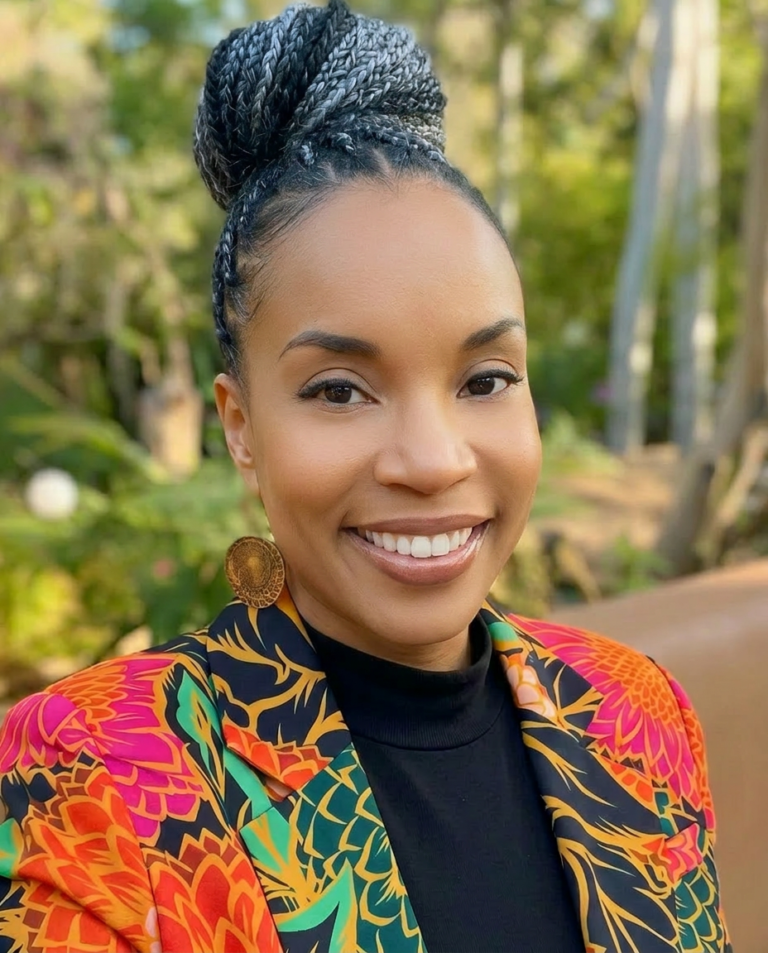
Photo Provided
Growing up in Lansing, Michigan, Sarah Anthony used to walk past the state capitol building and wonder what it would be like to work inside it. She pictured herself maybe cleaning its floors one day, maybe landing a job in policy if she was lucky. Becoming a senator never crossed her mind.
Today, Anthony sits inside those same walls as the first Black woman in Michigan history to chair the Senate Appropriations Committee, steering an $80 billion-plus state budget through a single guiding question: who is being left out, and what will it take to bring them in. From passing the CROWN Act to launching the Michigan Reconnect Scholarship to defending Medicaid and confronting the state’s literacy crisis, her leadership blends hard data with deep faith, and a firm refusal to leave any part of her identity behind.
At the Congressional Black Caucus Annual Legislative Conference in Washington, D.C., Anthony opened up about affordability, access, and the lessons she’s bringing back home to Michigan.
Before we dive in, tell us about your upbringing and what led you to the Senate.
I was born and raised in Lansing, Michigan, which is the capital of Michigan. People need to know there are more than just Black folks in Detroit and Flint. We are everywhere. It’s a smaller, middle-class town. My family worked in the auto industry and for state government. Growing up, I would pass by the state capitol, this beautiful building, and never imagined actually serving inside it one day. I thought maybe I might be in there cleaning the floors or working in policy, but never imagined serving as a senator.
God had a plan, though, and He wanted me to represent my hometown. After college, I came back and ran for office because there were not enough people in those halls of power who could truly articulate the needs and challenges facing people like me. That is something I have never forgotten. I show up every day as a Black woman, as someone from a middle-class family, and as someone who will never forget that a lot of people out there need help. They need a voice and a champion who is not going to forget about them after the door closes. I try to lead with integrity, with faith, and with my Blackness fully intact. It has been an honor to serve for about 20 years in public service.
Families across the country are feeling squeezed by rising costs of housing, healthcare, childcare, and education. What can state governments do now to provide meaningful relief?
We are in the find-out phase right now, if folks know what I mean. The direct impact of federal policies is showing up in our pocketbooks. Gas prices, grocery costs, childcare expenses through the roof, housing costs, mortgage rates all of it is a direct result of decisions being made at the federal level. At the state level, because I oversee the state budget, we are kind of left holding the bag, like many of us are in our normal lives. Somebody else makes a decision and we have to make it work. So that is what I do every day as the Appropriations chair in Michigan: figure out how to use tax dollars for good for people.
How do you use the budget as a tool to expand opportunity and strengthen economic security?
Let me give you two quick examples. A few years ago, I helped create the Michigan Reconnect Scholarship, which is for working adults ages 21 and older. It says: if you need a credential or an associate’s degree, you can get that for free in Michigan. That is both a policy decision and a budget decision, and now anyone in the state can pursue a college degree at no cost.
The other example is childcare. Women typically bear the brunt of those costs. By pouring more money into childcare and pre-K for all kids, we have made childcare significantly more affordable in Michigan. These are budget decisions. Even while the federal government continues to fall short, we are doing what we can at the state level. But we cannot hold the bag forever. We need better people at the federal level because we simply cannot do it all alone.
What measures should determine whether billion-dollar investments are actually improving residents’ lives?
What I have dedicated my life to is making sure we infuse a racial equity lens into everything we do. When someone announces 100 new jobs, the next question has to be how many of those jobs will go to Black and Brown folks. When a new factory is coming, who are the construction workers building it? Who are the contractors and consultants? Is the community actually benefiting from these big deals?
We need to demand more from everyone making those announcements. Saying we will have economic development is one thing. Making sure we look out for communities along the way is another. I also want to say that, especially for Black women but really for everyone, we need to learn how to chew gum and walk at the same time. We can look out for people and still have good business sense. When I was overseeing the first budget I helped build in 2023, we were negotiating big numbers while simultaneously passing the Crown Act in Michigan. You can manage 80-plus billion dollar budgets and still stand in the gap for Black women and Black children who are locked out of opportunities by discrimination.
How can states ensure that publicly funded economic development creates lasting benefits for residents?
Intentionality at the front end is everything. What I like to do is bring the community in at the beginning. We do not just want any kind of job. We want jobs with living wages, jobs that are permanent, and companies that are responsible to the communities they enter. What is their responsibility to the local school district? How will they ensure roads and bridges stay functional? Are they going to be a responsible neighbor when it comes to air quality? Building those requirements in at the front end means you do not have to fight for them on the back end. It just takes more intentional policy leaders who are thinking about communities from the start, not as an afterthought.
As federal priorities shift, what responsibilities do states have to protect access to healthcare, education, and essential services?
This is the meat and potatoes, Porsha. The federal government has passed some of the most damaging things in the last couple of years, and states are left holding the bag. Food assistance reductions in SNAP, for example, mean our kids and our elders are at risk of not eating. At the state level, we have to reimagine our budgets and rob Peter to pay Paul to make sure nobody goes hungry. The same goes for healthcare. When Medicaid gets cut, we have to get creative and trim somewhere else so that people do not lose their coverage. We do not have enough money to do it all, but that is exactly why the work matters.
Which policy tools can states use most effectively to improve access to healthcare while making care more affordable?
At the state level, safeguarding Medicaid to the degree we can is a priority. Beyond that, what I hear constantly from people is the cost of prescription drugs. These are life-saving medications keeping people alive, and they are becoming unaffordable at the pharmacy counter. There are ways we can chip away at some of those cost drivers, but reining in prescription drug costs ultimately requires action at the federal level. A significant part of the work right now is advocating loudly for better leaders who will actually deal with this issue.
What would a stronger pathway from early education to good-paying careers look like, and where are students being lost along the way?
Our literacy crisis is what keeps me up at night. Whether it is a third or fourth grader still not reading at grade level, or adults I am encountering who can barely read or comprehend, this is a real and urgent problem. What kind of job can you get in the new economy if you cannot read the basics? Whatever resources, tools, and training for our educators that it takes addressing literacy has to be the number one priority. Some of it we can tackle at the state level, but the federal government needs to be a real partner. Regardless of what happens there, we are going to save ourselves and make sure our children and our neighbors can actually read.
What does equitable access to opportunity actually look like in practice for communities historically excluded from public investment?
This is something I grapple with a lot. There are grant opportunities at the state level, the federal level, and in philanthropy, but often our people do not have the tools to apply for them. So what I try to do is tell folks that government can be a good tool. In my time as Appropriations Chair, we have invested a historic amount in Black and Brown businesses, minority-owned businesses, and women-owned businesses. We can always do more, but it is a good start.
People also need to make sure that folks like us are actually elected to office and placed in committees and positions where they can look out for our communities. Most of the businesses we own are small businesses boutique salons, nail shops, hair salons. Those are the businesses that make our communities thrive, and government needs to be funding those types of opportunities.
As the first Black woman in Michigan history to chair the Senate Appropriations Committee, how has your lived experience shaped who benefits from the state’s investments?
If this were a two-hour conversation, we could go through it completely. What I will say is that I do not leave any part of my journey behind when we are negotiating budgets. When we looked at education funding, we did so with an equity lens. The poorest and Blackest school districts should not be getting the least amount of money. From business support to healthcare, all of those decisions are informed by my experience and by the data.
When people try to argue that we should not be investing in communities of color, the data shuts that conversation down. The data shows gaps in educational outcomes and health outcomes, which means more interventions are needed, not fewer. Being the first Black this or the first woman that has to mean something. That is what I have tried to do in this role over the last four years.
What issue demands the most urgency, and what action should follow the conversations happening here at the Congressional Black Caucus?
There is so much energy here. Grassroots organizers, policy leaders, all of it. What I am leaving with is a renewed charge on two fronts.
First, getting out the vote. This really does feel like the most important election. The last few years have seen the federal workforce gutted, which disproportionately means Black workers. So much of what we built over the past 20 years has been uprooted. Getting organized and getting our people out to vote is non-negotiable.
Second, we need to guard the change. If we change the guard of leaders, we have to hold those new leaders accountable after the election. I am leaving with a renewed sense of advocacy so that we hold people’s feet to the fire if they do not show up for us the way they do during campaign season.
Follow Senator Sarah Anthony on all platforms at @sarahanthony517. Reach her through her legislative website for policy questions, suggestions, or to get in touch directly.
Source: According to Porsha, featuring Porsha Monique and Sarah Anthony
About the Author