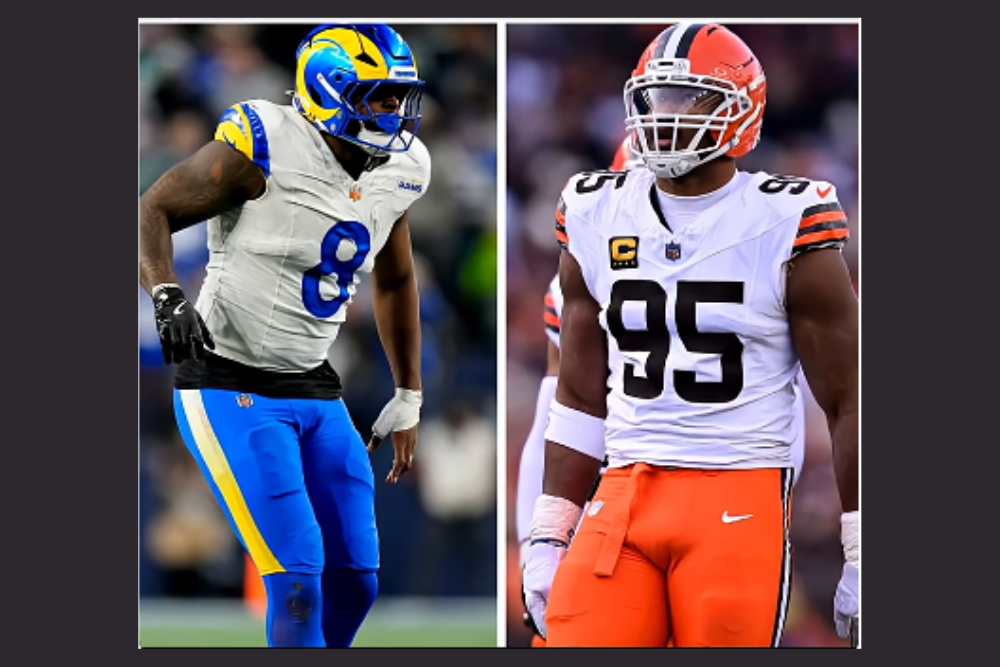
Photo screenshot: @GarrettBush YOUTUBE/Jared Verse Gets REAL About the Myles Garrett Trade 👀
The Rams built a dream team. History says be careful
Los Angeles loaded up with elite talent this offseason, but the 2011 Eagles show how fast that can unravel
The 2026 Los Angeles Rams have assembled what many consider the most talented roster of the Sean McVay era. On paper, no team in the NFL looks better heading into the season. However, history offers a cautionary tale about what happens when a team bets everything on a single offseason of additions.
What the Rams added this offseason
Los Angeles made several high-profile moves before training camp. The headlining addition was pass rusher Myles Garrett, one of the most dominant edge defenders in the league. On the back end, the Rams traded for cornerback Trent McDuffie in a deal that ranked among the largest compensation packages ever given for a corner. They also signed cornerback Jaylen Watson as a free agent, selected quarterback Ty Simpson in the draft as a developmental option behind their starter, and added tight end Max Klare to round out the group.
View this post on Instagram
The 2011 Eagles comparison
Fifteen years ago, the Philadelphia Eagles attempted something similar. Over a single offseason, they brought in cornerback Nnamdi Asomugha on a major free agent deal, acquired cornerback Dominique Rodgers-Cromartie in a trade, signed edge rusher Jason Babin following a 12.5-sack season, added defensive tackle Cullen Jenkins, wide receiver Steve Smith, running back Ronnie Brown and guard Evan Mathis, and brought in Vince Young as a backup quarterback with long-term potential.
The parallels to the current Rams roster are hard to ignore. Both teams addressed secondary concerns with two significant corner additions, one through free agency and one through a trade. Both added a premier pass rusher coming off a dominant season. Both drafted or signed a developmental quarterback with an eye toward the future.
Why the Eagles fell apart
The Eagles finished that season 8-8 and missed the playoffs entirely. Their failure came down to a core problem that no amount of talent can fix: the new players did not fit the existing system.
Asomugha had built his reputation as a man coverage cornerback in Oakland, operating largely on an island. The Eagles, by contrast, ran a zone-heavy defense. Rodgers-Cromartie was also a zone-first corner. Putting both into a scheme that asked them to operate differently than they had throughout their careers limited what either could produce.
The defensive coordinator, Juan Castillo, struggled to find answers. Andy Reid had promoted him out of loyalty rather than experience on that side of the ball, and the results showed. After two straight disappointing seasons, Reid was let go following 2012. The dream team label followed the Eagles as a warning rather than a legacy.
What the Rams are doing differently
The Rams are aware of the pressure. The organization has set its own standard at a Super Bowl or nothing, and the roster has been built with that bar in mind. The additions are aggressive, but the team has also been deliberate about fitting players to McVay’s system rather than simply collecting names.
That awareness does not guarantee success. Expectations this high leave little room for the kind of adversity that every NFL team encounters across a full season. Injuries happen. Chemistry takes time. The gap between a great roster in June and a championship team in February is wider than it appears.
What the Rams have going for them is that they understand all of this. Starting the season at zero wins regardless of reputation is something they have acknowledged publicly, and that mindset is a better starting point than the confidence that eventually undermined the 2011 Eagles.
SOURCE: Yahoo
About the Author