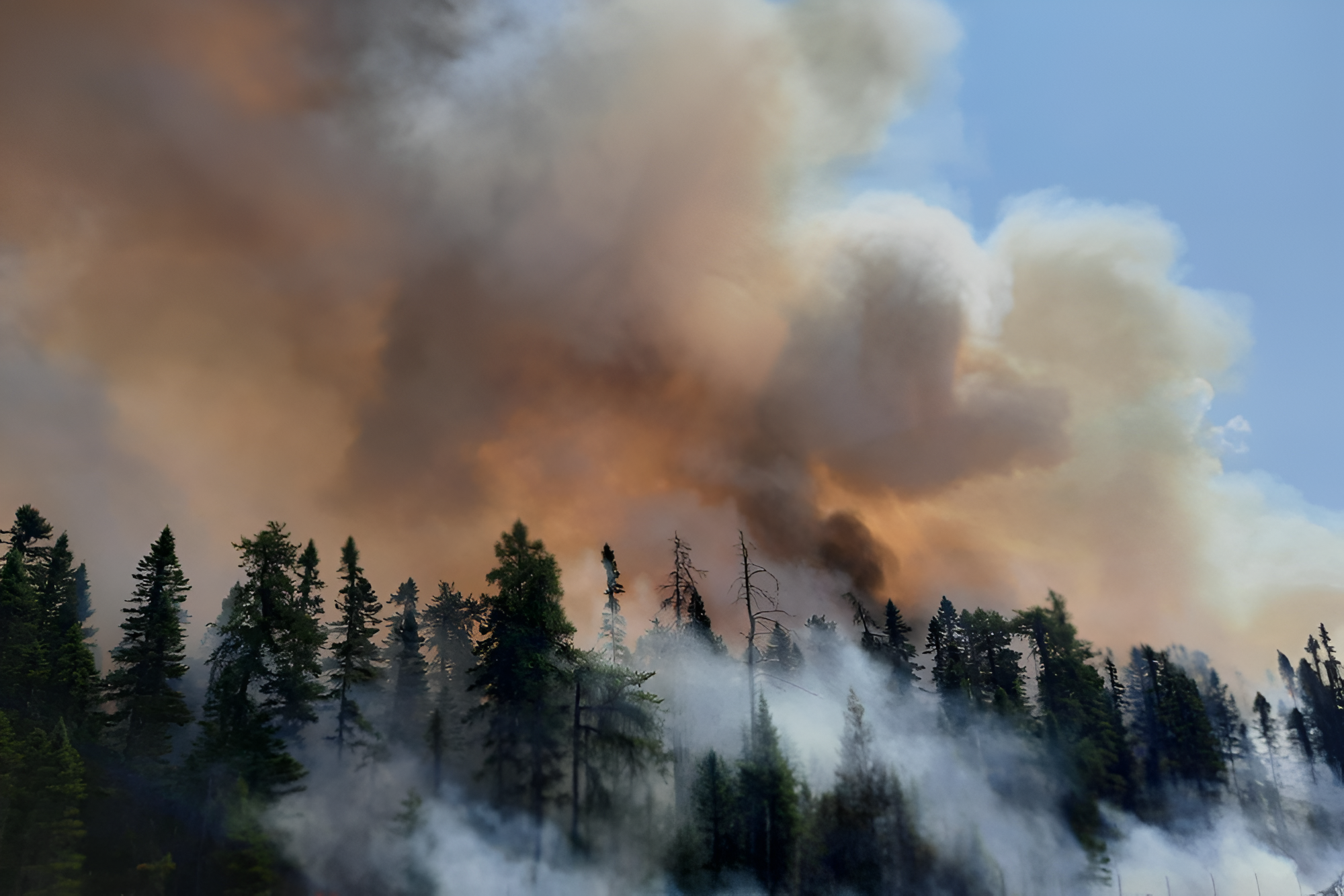
Courtesy: wildfire (X)
Hazy skies have settled over large parts of the eastern United States this week and the reason traces back to Canada. Hundreds of wildfires burning across the country have sent thick smoke drifting south, pushing air quality into unhealthy territory across 18 US states and the District of Columbia. More than 100 million Americans are currently under air quality warnings.
Canada’s national wildfire tracker reported 893 active fires as of July 17. Of those, 209 are classified as out of control, meaning crews do not expect the fires to stay within current boundaries. Another 47 fires are being actively held, while 95 are under control. Officials also reported 26 new fires on July 17 alone. Nationwide, nearly 6.9 million acres have burned so far this year.
What caused this year’s wildfires to grow so large
No single factor explains the scale of this year’s fire season. Drought conditions, dry vegetation, unusually hot weather and repeated lightning strikes have combined to fuel fire growth across multiple provinces. The highest concentrations of activity are burning in Ontario, Manitoba, Saskatchewan, British Columbia, Quebec and the Northwest Territories.
Canada remains at National Preparedness Level 4, the country’s highest classification, reflecting how much pressure the fires are placing on firefighting resources nationwide. Of the 26 new fires reported in mid-July, officials classified nine as human-caused, 13 as naturally caused and four as still undetermined.
How bad the air quality has become across the US
Washington, DC currently has the worst air quality on the East Coast. Officials there warned that pollution levels are dangerous even for healthy adults, not just those with existing health conditions. Delaware issued a Code Red Air Quality Action Day for July 17, meaning conditions are unhealthy for sensitive groups. Some parts of the state reached the purple range Friday morning, signaling very unhealthy air for everyone. Areas of Delmarva near the Maryland border sit in the red range.
Smoke has also settled heavily over New Jersey and the broader Northeast. National Weather Service forecasters said smoke from wildfires in western Ontario will likely remain over the region through Saturday. Winds are expected to push smoke south during the day Friday, then back north overnight into Saturday.
When the smoke might finally clear
Relief is not expected until Saturday night at the earliest. A cold front moving through the region should help disperse the smoke, according to National Weather Service forecasters in Mount Holly, New Jersey. Scattered thunderstorms tied to that front may also help clear pollutants from the atmosphere in parts of the Northeast.
Even with that improvement, the wildfires themselves have no clear end date. Canada’s fire season typically runs through summer and into fall, and officials have not indicated when the largest fires will be fully contained or extinguished. Health officials continue to recommend limiting outdoor time, keeping windows closed and running air conditioning on recirculate mode. For anyone who must go outside during periods of poor air quality, a well-fitted N95 or KN95 mask offers the most protection, while cloth masks provide little benefit against wildfire smoke.
SOURCE: Yahoo
About the Author