

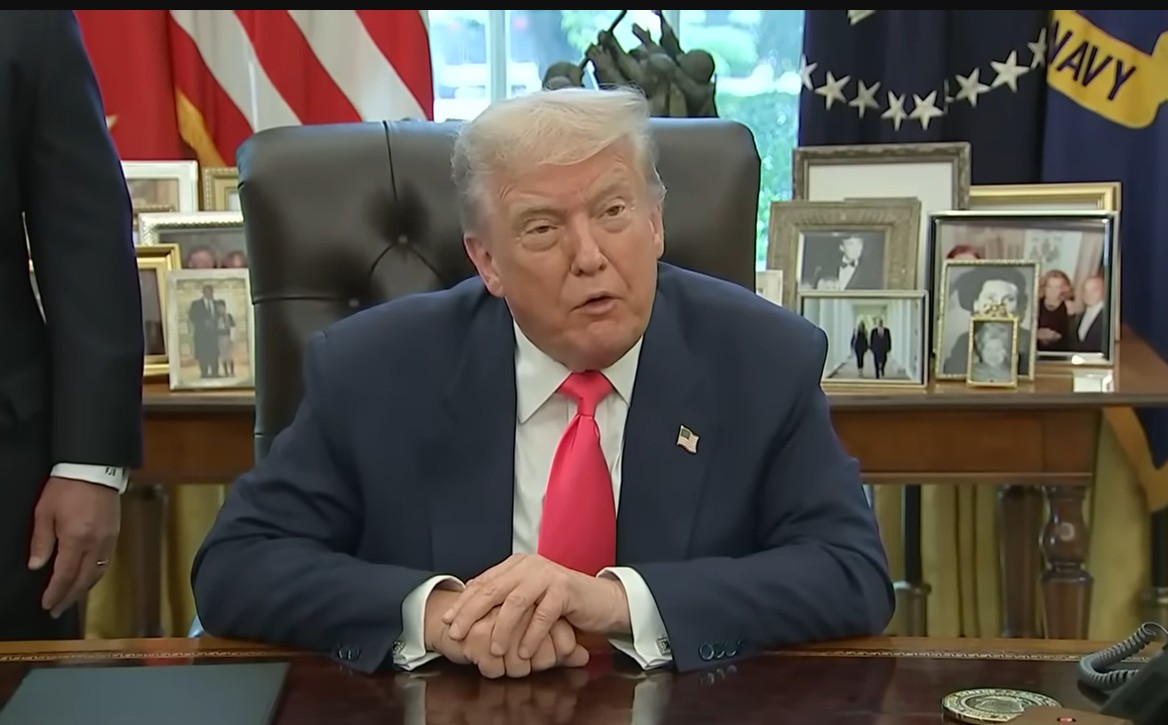
Courtesy of FOX News (YouTube)

President Donald Trump renewed controversy around the Chagos Islands after publicly condemning the United Kingdom’s decision to return the Indian Ocean archipelago to Mauritius, a move he portrayed as reckless and damaging to Western security interests.
The dispute centers on Britain’s agreement to hand sovereignty of the islands to Mauritius while maintaining access to Diego Garcia, the largest island and the site of a strategically vital joint US-UK military base. The base has long played a role in operations across the Middle East, Africa and Asia, making the territory one of the most sensitive military locations under Western control.
Trump’s remarks represented a sharp reversal from his earlier stance, when he had signaled support for the agreement. His renewed criticism reignited debate over Britain’s colonial legacy, international law and the future of one of the world’s most strategically placed island chains.

1. Strategic concerns tied to Diego Garcia
At the center of Trump’s argument is the military value of Diego Garcia. The atoll has served for decades as a hub for long-range bombers, naval forces and intelligence operations. Any shift in sovereignty, even with lease protections, is viewed by critics as introducing uncertainty into long-term defense planning.
Supporters of the deal argue that the lease arrangement ensures uninterrupted military use while resolving a long-standing diplomatic dispute. Trump, however, framed the handover as weakening control over territory he considers essential to national security, suggesting that strategic land should not be relinquished even symbolically.
The concern reflects broader anxieties among defense hawks about maintaining unquestioned authority over overseas bases in an increasingly competitive geopolitical environment.
2. A colonial legacy under international pressure
Britain retained control of the Chagos Islands after Mauritius gained independence in the 1960s, separating the territory from the former colony. In the years that followed, thousands of Chagos islanders were forcibly removed to make way for the military base, an episode that has remained a stain on Britain’s record.
Displaced residents have pursued compensation and the right of return through British courts for decades, keeping the issue alive in the public consciousness. Their struggle gained international momentum in 2019, when the International Court of Justice advised Britain to end its administration of the islands and complete decolonization.
Although the ruling was advisory rather than binding, it increased diplomatic pressure on London to act. The agreement with Mauritius is widely seen as a response to that pressure, aimed at aligning Britain with international legal opinion.
3. Shifting alliances and political messaging
Trump’s renewed criticism also reflects his broader approach to foreign policy, which often emphasizes territorial control and skepticism toward international institutions. By denouncing the deal, he aligned himself with arguments that prioritize unilateral strength over multilateral legal frameworks.
The comments also carried political symbolism, signaling a tougher posture toward allies perceived as making concessions. For Britain, the criticism landed at a sensitive moment, as leaders attempt to balance legal obligations, moral responsibility and strategic partnerships.
Mauritius, meanwhile, has framed the agreement as a long-overdue correction of historical injustice, while emphasizing its commitment to maintaining the security role of Diego Garcia.
As debate continues, the Chagos Islands remain a flashpoint where colonial history, global security and modern diplomacy collide. Trump’s remarks ensured that the issue, once largely confined to legal circles, has again moved into the international political spotlight.
About the Author



1 thought on “Trump blasts UK in explosive Chagos Island deal controversy”