

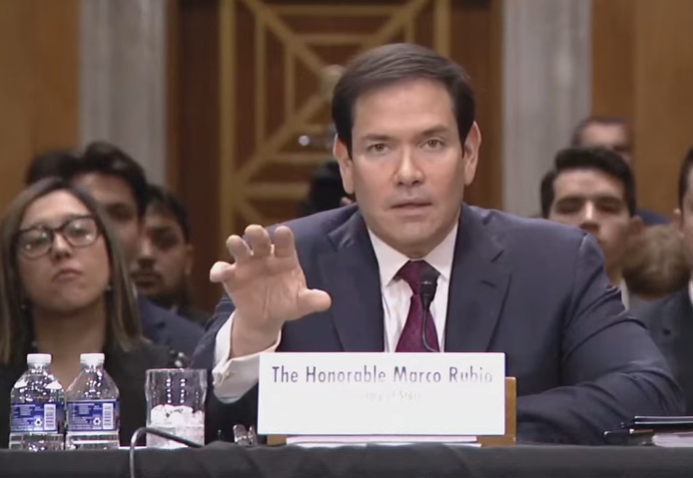
Courtesy: CNBC-TV18
U.S. Secretary of State Marco Rubio appeared before the Senate Foreign Relations Committee on Jan. 28, outlining the Trump administration’s position on Venezuela’s recent upheaval and its ongoing policy in the wake of the removal of Venezuelan President Nicolás Maduro. Rubio described Maduro as an impediment to progress, saying that efforts to reach a diplomatic settlement with him had failed before a sudden U.S. military operation removed him from power earlier this month.
The hearing came less than a month after U.S. forces conducted a surprise operation in Caracas on Jan. 3, resulting in Maduro’s capture and transport to the United States to face federal charges. While Maduro awaits trial in a New York federal court on accusations including drug trafficking and narco-terrorism, Rubio and other administration officials have continued to defend their actions and outline the path forward.
U.S. operation that ousted Maduro
The operation that brought Maduro into U.S. custody involved an elite unit and was part of a broader campaign that the Trump administration says targeted corruption and criminal networks tied to the Venezuelan leadership. Officials have maintained that the mission was limited in scope and that there are no U.S. ground troops remaining in Venezuela, framing the action as a law enforcement effort rather than an occupation.
Rubio used the Senate hearing to reinforce that message, emphasizing the administration’s intent to steer Venezuela toward a transition aligned with U.S. interests. This includes cooperation on issues such as energy and drug interdiction, as well as encouraging free and fair elections once stability takes hold in the country. The secretary of state made clear that, from Washington’s perspective, Maduro’s unwillingness to negotiate had left few alternatives.
Tensions in Washington and the region
Lawmakers on both sides of the aisle remain divided over the best approach to Venezuela’s future. Some Republicans have supported the administration’s actions as a legitimate use of presidential authority, while many Democrats and foreign policy experts have raised concerns about executive overreach and the legality of military intervention without clear congressional approval. Critics argue that even after Maduro’s capture, much of his former regime remains influential within Venezuela’s political framework.
For its part, the Trump administration insists that any future use of force would only be considered if cooperation from Venezuela’s interim leadership faltered and other diplomatic avenues were exhausted. Rubio’s testimony underscored that stance, portraying Maduro’s prior refusal to engage as a factor that limited options and ultimately contributed to the decision to carry out the operation.
Attempts at normalization and future implications
In the weeks since Maduro’s removal, the U.S. has begun preliminary steps toward normalizing relations with the interim government led by Delcy Rodríguez, who was Maduro’s vice president and now serves as acting leader. The State Department’s notification to Congress about reopening the U.S. embassy in Caracas suggests a tentative shift toward diplomatic engagement, though progress is likely to depend on continued cooperation and compliance with U.S. expectations.
Meanwhile, U.S. intelligence has raised questions about how closely Venezuela’s interim leadership will align with Washington’s broader goals, particularly regarding ties with nations such as Iran, China and Russia. These uncertainties highlight the ongoing complexity of the situation as the U.S. navigates its role in Venezuelan affairs after the dramatic events of early January.
A contentious chapter in u.s.-venezuela relations
Rubio’s comments to the Senate reflect a broader debate over U.S. intervention in foreign nations and the balance between diplomatic negotiation and the use of force. With Maduro’s refusal to reach a deal playing a central role in the administration’s narrative, lawmakers will continue to debate the implications of recent actions and what they mean for U.S. foreign policy in Latin America and beyond.
Source: USA TODAY; additional reporting from Associated Press and Reuters.
About the Author




1 thought on “Tense showdown as Rubio blames Maduro for failed deal”