Courtesy;NASA
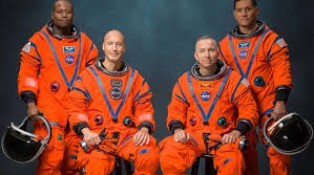
The Artemis III crew announcement marks another milestone in NASA’s long-term plan to return astronauts to deep space and eventually the lunar surface. The agency has selected four men with military, engineering and medical backgrounds to fly the 2027 mission, which will focus on testing critical systems needed before astronauts attempt another moon landing.
Although Artemis III is not expected to land on the moon, the mission represents one of the most important steps in preparing for future expeditions that could place humans on the lunar surface for the first time in decades.
Four astronauts bring decades of experience
The newly named crew blends seasoned veterans with fresh talent.
Commander Randy Bresnik enters the mission with multiple previous spaceflights and extensive leadership experience as a former Marine colonel and test pilot.
Pilot Luca Parmitano of the European Space Agency becomes the first ESA astronaut assigned to an Artemis mission. His selection highlights the growing international cooperation behind lunar exploration.
Mission specialist Frank Rubio brings medical expertise and holds the record for the longest single spaceflight by an American astronaut after spending more than a year aboard the International Space Station.
Mission specialist Andre Douglas will make his first trip to space after previously serving as a backup crew member for Artemis II. His engineering background and Coast Guard experience add another layer of technical expertise to the team.
Together, the four astronauts represent decades of service across aviation, science and space operations.
Artemis III focuses on preparation instead of landing
Unlike the Apollo missions that carried astronauts directly to the moon, Artemis III has a different objective.
The crew will launch aboard NASA’s Orion spacecraft and conduct operations in Earth orbit designed to validate future lunar missions. A key part of the flight involves rendezvous and docking exercises with commercial lunar landers being developed by private aerospace companies.
Successfully completing these demonstrations would provide valuable data before NASA attempts to send astronauts back to the lunar surface.
The mission also reflects NASA’s increasing reliance on partnerships with commercial providers to expand exploration capabilities beyond low-Earth orbit.
International collaboration plays a larger role
One of the most notable aspects of the Artemis III crew announcement is the inclusion of an astronaut from Europe.
Luca Parmitano’s assignment underscores the partnership between NASA and the European Space Agency, reinforcing that modern space exploration has become an international effort rather than the work of a single nation.
The collaboration extends beyond astronauts and includes technology development, scientific research and long-term planning for future lunar infrastructure.
Experience meets fresh perspective
Three members of the crew have previously traveled to space, giving the mission significant operational knowledge. Andre Douglas, meanwhile, will bring the perspective of a first-time astronaut who has spent years preparing through training and support assignments.
That balance may prove valuable as NASA tests new procedures and hardware designed for future exploration beyond Earth orbit.
The combination of veteran leadership and new talent also mirrors NASA’s broader strategy of building experience across multiple generations of astronauts.
Looking ahead to humanity’s next lunar chapter
The Artemis III crew announcement signals that preparations for future moon missions continue to gain momentum. While the 2027 flight will focus primarily on testing spacecraft operations and docking procedures, its success could pave the way for astronauts to once again walk on the lunar surface as early as the following mission cycle.
As NASA advances toward that goal, the four selected astronauts will carry not only scientific objectives but also the hopes of millions eager to witness the next chapter of human exploration beyond Earth.
Source: NASA
About the Author