Courtesy:NASA
For the first time in more than half a century, human beings are preparing to leave the safety of low Earth orbit and venture toward the Moon. NASA’s Artemis II mission a 10-day lunar flyby carrying 4 astronauts represents the most significant step in human spaceflight since the final Apollo missions of the early 1970s, and it is carrying a crew that makes history before the rocket even leaves the ground.
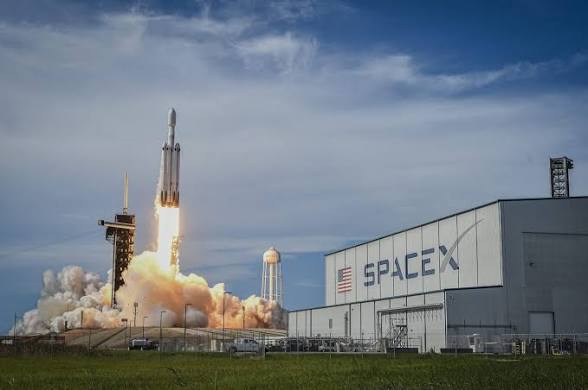
The Space Launch System rocket and Orion spacecraft are being prepared at Kennedy Space Center in Florida, where teams are working through a detailed checklist before the massive vehicle makes its slow four-mile journey from the Vehicle Assembly Building to Launch Pad 39B — a crawl that can take up to 12 hours on the specialized transporter that carries it.
The 4 astronauts making history
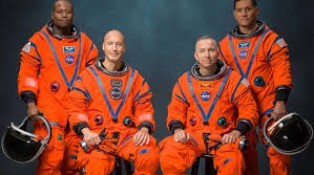
The crew of Artemis II carries 4 individuals whose presence aboard Orion collectively represents several milestones that the human spaceflight program has never achieved before. Commander Reid Wiseman leads the mission, with pilot Victor Glover, mission specialist Christina Koch, and Canadian Space Agency mission specialist Jeremy Hansen rounding out the team.
Koch will become the first woman ever to travel toward the Moon. Glover will be the first person of color to make the journey. Hansen will be the first Canadian to fly on a lunar mission. Together they represent a crew that looks genuinely different from every Moon-bound crew that came before them, a reflection of how the program has evolved since the Apollo era.
What the mission actually does
Artemis II is not a landing mission. It is a dress rehearsal an essential and complex one designed to prove that every system aboard Orion can keep 4 people alive and functional on a journey that will take them approximately 6,000 miles beyond the far side of the Moon and cover nearly 600,000 total miles before splashing down in the Pacific Ocean.
The flight begins with Orion entering high Earth orbit to test life support systems under real spaceflight conditions. A powerful engine burn then sends the spacecraft on its looping path around the Moon and back. At its farthest point from Earth, the crew will be farther from home than any humans have traveled since the final Apollo mission in 1972.
What the crew will study and why it matters
As Orion swings around the lunar far side, the 4 astronauts will serve as field geologists in orbit, photographing impact craters, ancient lava plains, and large structures including the Orientale Basin while communicating in real time with scientists on the ground. The data they collect will help identify safe and scientifically valuable landing zones for Artemis III near the lunar south pole, where ancient rocks and buried ice could reveal how Earth and the wider solar system formed.
The mission is also a serious test of closed-loop life support systems that must sustain human life far from any possibility of rescue. Artemis II will carry radiation sensors, upgraded carbon dioxide removal systems, emergency fire masks, and organ-on-a-chip experiments that use human cells to study how deep space radiation affects the body. Water recycling systems aboard the International Space Station already recover approximately 98 percent of onboard water, and Artemis needs to reach similar levels for the longer journeys ahead.
The road to the Moon and beyond
Everything Artemis II proves or fails to prove will directly shape the timeline and safety of Artemis III, the mission designed to actually land humans on the lunar surface for the first time since 1972. NASA has been clear that hardware readiness will drive the schedule additional dress rehearsals will be added or the rocket rolled back indoors if any data raises concern.
The broader Artemis program envisions a lasting human and robotic presence around and on the Moon, not a series of brief visits. Artemis II is the essential first step toward that future.
Source: ECOticias / NASA
About the Author