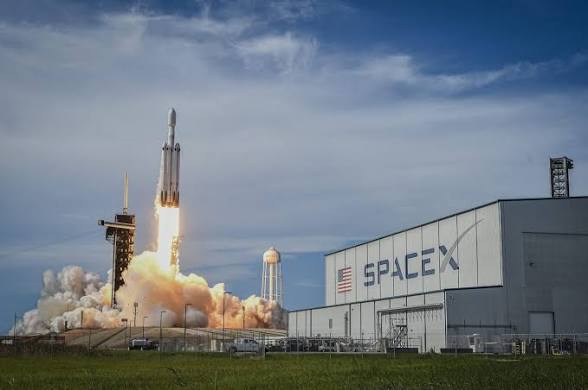
Courtesy:NASA

It is no April Fools’ Day prank. On Wednesday, April 1, 2026, NASA launched its Artemis 2 mission from Kennedy Space Center in Florida at 6:24 p.m. EDT — sending humans beyond Earth’s orbit for the first time in more than half a century.
The last time astronauts ventured to the moon was during NASA’s Apollo 17 mission in December 1972. That is more than 53 years without a human setting eyes on the lunar surface up close, and today’s launch marks the beginning of a bold new chapter in deep space exploration.
Riding aboard the Orion spacecraft atop a towering Space Launch System rocket, the four crew members are: 1) Reid Wiseman, who serves as commander, 2) Victor Glover, the mission pilot, 3) Christina Koch, mission specialist, and 4) Jeremy Hansen, a mission specialist from the Canadian Space Agency. The crew will spend 10 days on a journey around the moon before returning safely to Earth.
A crew that is breaking barriers in space exploration
Beyond the mission itself, this crew is quietly rewriting history with every mile they travel from Earth. Glover becomes the first person of color ever to travel beyond low Earth orbit. Koch is the first woman to do so. And Hansen becomes the first person who is not an American to venture that far into deep space.
All three milestones land in a single mission a reflection of how much the face of space exploration has changed since the all-white, all-American crews of the Apollo era.
What Artemis 2 is actually trying to accomplish
Despite the enormity of the occasion, Artemis 2 is technically classified as a test flight. Its primary objective is to demonstrate that the Orion capsule can safely support a human crew during an extended deep-space mission. This marks the capsule’s first-ever crewed flight, though it has flown twice before once during the uncrewed Artemis 1 mission in late 2022, and once during an uncrewed Earth-orbit test back in 2014.
Think of this mission as NASA proving out the hardware before things get even more ambitious.
The bigger picture: what comes next after Artemis 2
NASA’s plans do not stop here. Artemis 3, currently scheduled for 2027, will test Orion’s ability to dock with one of two crewed lunar landers in development SpaceX’s Starship and Blue Origin’s Blue Moon. That mission will not land on the moon, but it is a critical step toward the one that will.
That would be Artemis 4, currently targeted for late 2028, which aims to set down astronauts near the moon’s south pole a region rich in resources that NASA believes could support a long-term human presence. The agency envisions a series of crewed and robotic missions gradually building up infrastructure near the pole, eventually serving as a launchpad of sorts for even more distant ambitions.
Mars is the ultimate destination
The moon, in NASA’s current thinking, is not the final stop. It is the proving ground. Everything the agency learns about keeping astronauts alive and productive in deep space will feed into what it hopes will be crewed missions to Mars sometime in the 2030s or 2040s.
That long-term vision is what sets the Artemis program apart from Apollo. The original moon landings were driven largely by Cold War competition with the Soviet Union plant the flag, come home, win the race. Artemis is designed to build something lasting.
Today’s launch may have echoed the spirit of those earlier missions, but it is pointing firmly toward the future.
Source: Space.com
About the Author