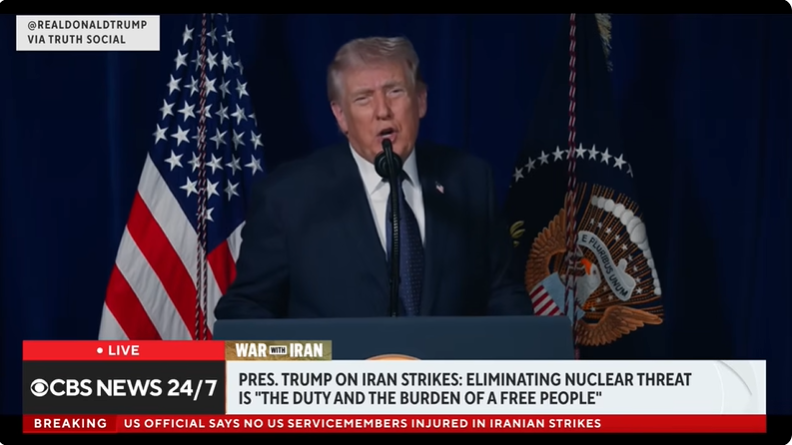
President Donald Trump says the United States has launched what he characterized as a necessary military operation against Iran, framing the action as a move to prevent Tehran from advancing its nuclear and ballistic missile capabilities.
In a video shared on Truth Social, Trump said the mission, called Operation Epic Fury, was designed to eliminate what he described as escalating threats tied to Iran’s weapons development and regional military posture. He maintained that an Iran equipped with long-range missiles and nuclear capacity would pose a danger to Americans and U.S. allies.
The president positioned the operation as both immediate defense and long-term protection for future generations, arguing that national security concerns required decisive action.
Trump outlines 3 key elements of the operation
As details emerged, the White House highlighted 3 major components of the unfolding conflict.
Confirmation of U.S. casualties
Trump confirmed that three U.S. service members were killed during the operation. Five others were reported seriously wounded. He paid tribute to the fallen troops and described their deaths as a sacrifice made in the service of national security. The Pentagon has not yet publicly released the names of those killed, pending notification of families.Destruction of Iranian naval assets
In a separate social media post, Trump said U.S. forces destroyed and sank nine Iranian naval ships. He also reported significant damage to Iran’s naval headquarters. According to the president, additional operations remain underway as U.S. forces continue targeting infrastructure connected to Iran’s military capabilities.Call for surrender and immunity offer
Trump urged members of Iran’s Revolutionary Guard and military forces to lay down their weapons. He said those who surrender would receive immunity, while warning that continued resistance would be met with further military action. The administration has not released specifics on how any immunity process would be structured.
Breakdown in negotiations preceded strikes
The strikes follow weeks of indirect negotiations between U.S. and Iranian officials. According to senior administration figures, discussions collapsed over Tehran’s ballistic missile program. The White House has indicated that Iran declined to curb missile development as part of a broader diplomatic framework.
Officials say that breakdown prompted the administration to move forward with military planning already underway. Trump has since signaled that diplomacy could resume under different conditions, suggesting that recent events may shift the dynamic of future talks.
Congress weighs constitutional questions
As the situation escalates, lawmakers are assessing whether the president should have sought authorization from Congress before initiating the strikes. Some members argue that military action of this scale typically requires legislative approval under the Constitution.
Others have defended the president’s authority, pointing to prior executive actions taken under existing military force authorizations. Congressional briefings are expected in the coming days as lawmakers seek additional intelligence and operational details.
White House frames action as preventative
The administration continues to describe Operation Epic Fury as a preventative mission rather than an open-ended war. Trump has emphasized that the goal is to eliminate what he views as intolerable threats and to ensure that Iran does not expand its nuclear reach.
While the broader regional impact remains uncertain, the president has maintained that U.S. military strength gives the country the ability to act decisively when necessary.
For now, the White House message remains consistent: the United States will use its military capabilities to counter perceived threats and will continue operations as commanders deem appropriate.
Source: CBS News
About the Author

Praise Swint
Wpseo_editor
Praise Swint is a contributor at Revelence, covering stories across news, entertainment, and culture.