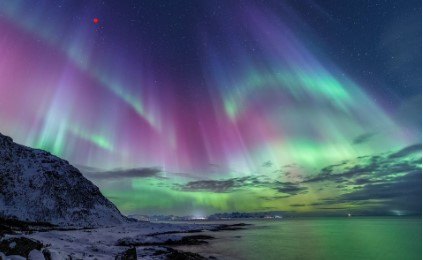
If you live near the U.S.-Canadian border, Monday night may be worth stepping outside for. The northern lights could appear visible from parts of the northern United States on June 8, 2026, according to a forecast from the National Oceanic and Atmospheric Administration. The northern lights forecast June 2026 event follows a burst of solar material that left the sun on Saturday and is now approaching Earth. As a result, geomagnetic storm conditions are expected to intensify through Monday evening and into early Tuesday morning.
What NOAA is predicting
NOAA is forecasting a Kp index of five out of nine for Monday night. That level is significant because it means the aurora could become visible from parts of the contiguous Lower 48 states. Furthermore, the agency is predicting geomagnetic storms reaching up to G3 on its five-point scale. Storms at that level are considered moderate to strong. While the overall activity is likely to remain mild to moderate through most of the night, NOAA warns that periods of stronger storming could occur specifically during Monday evening.
What is a coronal mass ejection
The event driving Monday’s forecast is a coronal mass ejection, or CME. These are large bursts of plasma and magnetic field that escape from the sun’s corona — its outermost layer of atmosphere. When that material reaches Earth, it interacts with the planet’s own magnetic field. That interaction produces geomagnetic storms. In turn, those storms energize particles in the upper atmosphere, which then emit the colorful light displays known as the northern lights. During periods of strong activity, the aurora can extend well into the contiguous U.S. In the most powerful recent events, displays were visible from all 50 states. Monday’s storm is not expected to reach that level. However, the 9 states along the northern border have a genuine chance of seeing something.
The 9 states with the best chance of visibility
NOAA forecasts the best viewing opportunities in a band along the U.S.-Canadian border. The 9 states with the highest chance of visibility are: 1. North Dakota; 2. Minnesota; 3. Michigan, specifically the Upper Peninsula; 4. Montana; 5. Washington, primarily the northernmost portions; 6. Idaho, in its northernmost areas; 7. South Dakota, in its northernmost areas; 8. Wisconsin, in its northernmost areas; and 9. Alaska, which NOAA rates as having a high chance of visibility significantly better odds than the Lower 48 states.
NOAA describes the overall chance of visibility in most of the continental states as generally low. However, Alaska stands apart with a strong forecast for aurora activity throughout the night.
How to see the northern lights tonight
If you want to give yourself the best chance of catching the aurora, location and timing matter. NOAA recommends traveling as far north as possible toward Earth’s magnetic north pole in northern Canada. Once in position, find an elevated spot such as a hill with a clear, unobstructed view of the northern sky. Avoid areas with significant light pollution. Street lights and city glow can wash out the aurora entirely, especially when activity is moderate rather than extreme.
Timing is also critical. The northern lights are typically most active around midnight. NOAA specifically highlights the window between 10 p.m. and 2 a.m. as the peak viewing period on any given night.
How to photograph the aurora
You do not need professional camera equipment to capture a good aurora photo. According to experts who spoke to National Geographic, modern smartphone cameras are more than capable of producing quality images. However, a few adjustments make a significant difference in the results.
First, switch your device to night mode before shooting. Second, turn off the flash entirely. Third, shoot in RAW image format if your phone supports it, as this preserves more detail for editing afterward. Finally, and most importantly, keep the camera completely still during the shot. Aurora photography requires longer exposure times to capture the light. Investing in a small tripod and a remote timer removes the risk of camera shake and consistently produces sharper, brighter results.
Source: Forbes / NOAA
About the Author